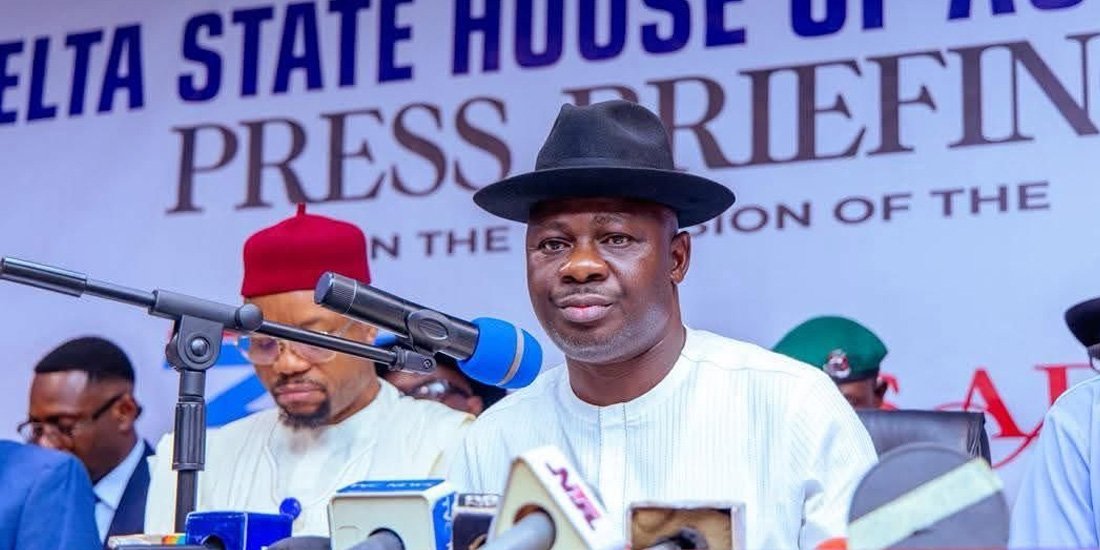
The Speaker of the Delta State House of Assembly, Rt. Hon. Emomotimi Dennis Guwor, has said the 8th Assembly passed five bills during its third legislative session, including the 2026 Appropriation Law of N1.729 trillion, as part of efforts to strengthen governance and drive development in the state.
Guwor made this known on Thursday during a press briefing in Asaba to mark the third anniversary of the 8th Assembly.
He said the House received a total of 11 bills within the period under review, comprising five executive bills and six private members’ bills. According to him, five of the bills were passed, four of which have already been assented to by Governor Sheriff Oborevwori, while one is still awaiting assent.
The Speaker listed the key legislations passed to include the 2026 Appropriation Bill, the 2025 Supplementary Appropriation Bill, the Delta State Anti-Terrorism and Anti-Cultism (Amendment) Bill 2025, the 2024 Appropriation (Amendment) Bill, and the Delta State Revenue Service Bill 2026.
He explained that the Assembly increased the 2026 budget estimate from N1.664 trillion to N1.729 trillion to accommodate additional funding for critical projects and programmes across the state.
“One of the practical demonstrations of the House’s support for infrastructural development was the approval of the 2026 Appropriation Law. The House appropriated the sum of N1.729 trillion as against the N1.664 trillion initially presented by His Excellency, the Governor,” he said.
Guwor noted that the Delta State Revenue Service Bill was designed to enhance revenue generation, reduce multiple taxation, and improve the ease of doing business to attract investment into the state.
He also highlighted the Assembly’s oversight activities, including the consideration of audit reports on the accounts of the state government, the Delta State Oil Producing Areas Development Commission (DESOPADEC), and the 25 local government councils.
According to him, the House has also established a Post-Legislative Scrutiny Department to monitor and evaluate the implementation of laws passed by the Assembly, making Delta State the second in the country after Oyo State to adopt such a structure.
On institutional reforms, Guwor disclosed that the Assembly hosted its first-ever reunion of both serving and former members since its creation in 1992, describing it as a milestone in strengthening legislative history and continuity.
He also noted that the Assembly had gained national recognition, with its leadership occupying key positions in the Conference of Speakers of State Legislatures of Nigeria and other national legislative bodies.
Guwor commended Governor Sheriff Oborevwori for what he described as a productive relationship between the executive and legislature, adding that the partnership had supported the implementation of the state’s M.O.R.E Agenda.
He said ongoing projects across the state include flyovers in Uvwie, Warri, Ughelli and Agbor, as well as road construction, healthcare upgrades, and development initiatives in riverine communities.
The Speaker added that the Assembly had prioritised staff welfare and capacity development, including training programmes and the implementation of the Consolidated Legislative Salary Structure (CONLESS).
“As we look ahead, the 8th Assembly remains committed to enacting people-oriented legislation, strengthening oversight functions, promoting transparency and accountability, and supporting policies and programmes that will advance the growth, peace and prosperity of Delta State,” he said.