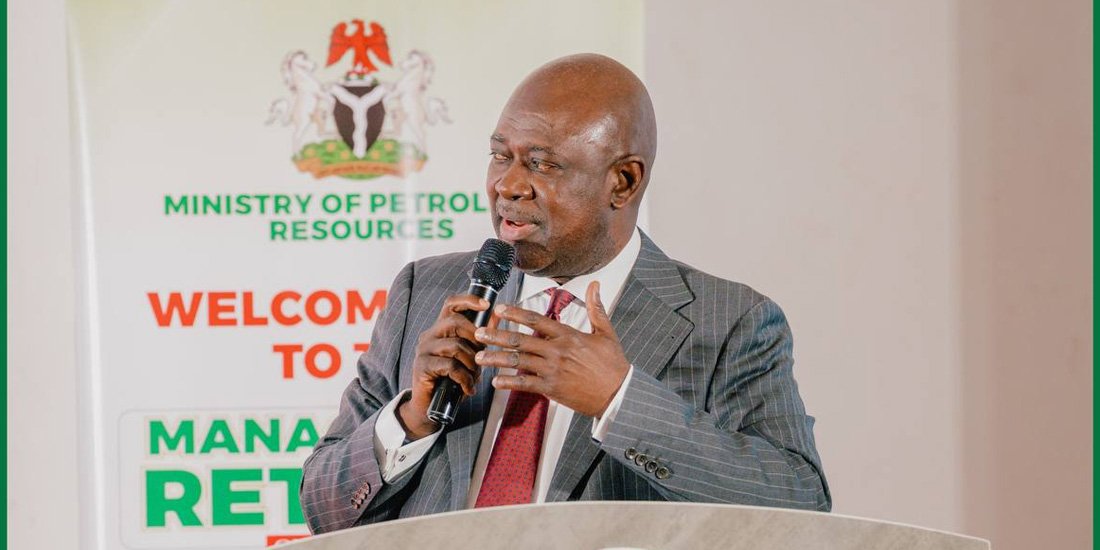
The Minister of State for Petroleum Resources (Oil), Heineken Lokpobiri, has said Nigeria’s crude oil and condensate production has increased by about 80 per cent since President Bola Ahmed Tinubu assumed office in May 2023.
Lokpobiri made the disclosure on Wednesday at the Ministry of Petroleum Resources’ 2026 Ministerial Retreat in Abuja, where he urged officials to develop a comprehensive framework for expanding the country’s hydrocarbon reserves through aggressive exploration and data-driven investment strategies.
The retreat, themed “Driving Institutional Performance and Accountability in the Nigerian Petroleum Sector for Sustainable National Development,” brought together senior ministry officials and key stakeholders in the petroleum industry.
According to the minister, Nigeria’s oil and condensate production has risen from about one million barrels per day when the current administration took office to approximately 1.8 million barrels per day.
“When I was appointed, I was given the mandate to ensure we ramp up production. At that time, our production was barely about one million barrels per day. Today, we are doing approximately 1.8 million barrels per day. That is over 80 per cent improvement. But we are not yet where we want to be,” Lokpobiri said.
Despite the gains, he noted that the country remains short of its target of 2.5 million barrels per day and stressed the need for intensified efforts to unlock Nigeria’s vast oil and gas potential.
Lokpobiri revealed that Nigeria currently holds an estimated 37 billion barrels of crude oil reserves and more than 209 trillion cubic feet of natural gas, figures he said have remained largely unchanged for decades due to limited exploration activities.
He expressed concern that successive administrations had failed to conduct comprehensive seismic studies aimed at identifying new oil and gas deposits, adding that the Tinubu administration is determined to reverse the trend.
“For over 30 years, no government has been able to undertake proper seismic exploration with a view to discovering more oil and gas reserves. This government is committed to changing that,” he stated.
The minister also highlighted what he described as growing investor confidence in Nigeria’s petroleum sector, attributing the development to reforms introduced by the federal government to improve the business environment.
According to him, the country is witnessing an unprecedented influx of investors into the oil and gas industry following policy reforms implemented by the administration.
Lokpobiri further noted improvements in Nigeria’s external reserves, which he said have exceeded $50 billion for the first time in 17 years.
“Our reserves are now above $50 billion, the highest level recorded in 17 years. These gains are the result of bold reforms and strategic decisions taken by this administration,” he said.
The minister observed that global energy discussions are increasingly shifting from energy transition to energy mix, creating new opportunities for oil- and gas-producing countries such as Nigeria.
He urged civil servants within the ministry to strengthen accountability, efficiency, and institutional performance, describing the civil service as critical to achieving the government’s development objectives.
Earlier, the Permanent Secretary of the Ministry of Petroleum Resources, Patience Oyekunle, said the retreat was designed to improve performance management, enhance reporting systems, and strengthen accountability across the ministry and its agencies.
She noted that the forum would provide an opportunity for stakeholders to review progress, identify challenges, and develop practical solutions to improve institutional effectiveness.
Also speaking, the ministry’s Director of Planning, Research and Statistics, Kemi Ahmed-Yusuf, said the ministry was focused on achieving key targets, including raising crude oil production to three million barrels per day, increasing gas supply, improving petroleum product availability, and strengthening local content development.
She noted that while the Petroleum Industry Act has provided a framework for industry operations, Nigerians continue to expect tangible improvements in performance, efficiency, and national development.
Representing the Executive Secretary of the Petroleum Technology Development Fund (PTDF), Prof. Shehu Aliyu, Waziri Laisu underscored the importance of results-based governance, noting that government performance is increasingly measured by implementation outcomes and the impact of policies on citizens.
He added that the federal government remains committed to strengthening public sector performance through the Central Results Delivery Coordination Unit and other accountability mechanisms aimed at delivering measurable development outcomes.