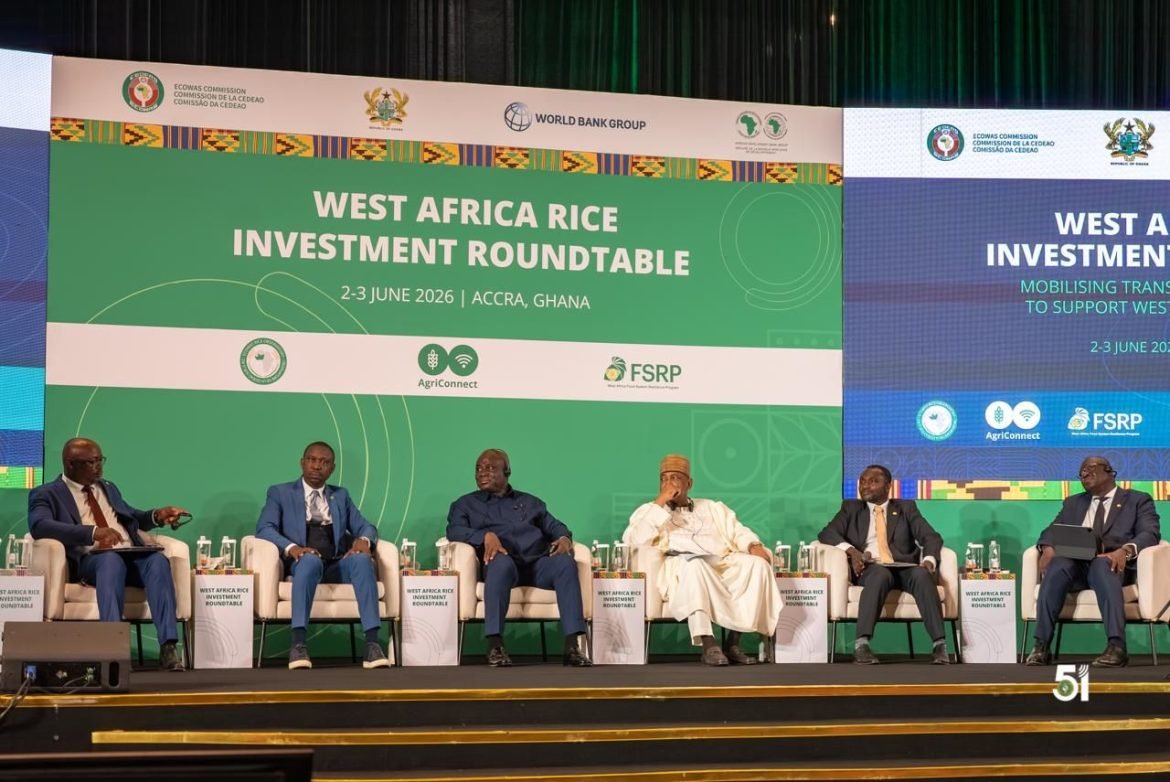
The Economic Community of West African States has launched an ambitious regional initiative to achieve rice self-sufficiency across West Africa by 2035, convening a high-level Regional Round Table on Investment in the Rice Sector in Accra to mobilize public, private, and blended financing required to implement national and regional rice development plans.
The meeting, organized by ECOWAS through its Department of Economic Affairs and Agriculture with support from the World Bank and the African Development Bank, comes at a moment of heightened urgency: West Africa possesses vast arable land, favorable climatic conditions, and a large agricultural workforce yet remains heavily dependent on imported rice, spending billions of dollars annually on a staple food that could be produced domestically.
Opening the roundtable on behalf of Ghanaian President John Dramani Mahama, Vice President Jane Naana Opoku-Agyemang said the challenge transcended agriculture and touched on economic sovereignty and sustainable development. She said the quest for rice self-sufficiency was fundamentally about Africa’s ability to transform its economies, deepen regional integration, and build resilience against global supply disruptions.
ECOWAS Commission President Omar Alieu Touray described the initiative as a defining moment in the bloc’s efforts to attain food sovereignty, saying the roundtable must go beyond declarations and serve as a catalyst for concrete investments capable of transforming the rice value chain across member states. He said the commission’s ambition was to establish competitive, inclusive, and sustainable agri-food systems that strengthened food sovereignty, created jobs, and promoted shared prosperity while achieving regional rice self-sufficiency by 2035.
A major highlight of the event was the presentation of “Vision for Rice Self-Sufficiency in West Africa by 2035” by ECOWAS Commissioner for Economic Affairs and Agriculture Kalilou Sylla, which outlined a comprehensive strategy to boost production, improve seed systems, expand irrigation infrastructure, strengthen mechanization, enhance processing capacity, and improve market access. Contributors included Ghana’s Minister of Food and Agriculture Eric Opoku, World Bank Vice President for Global Environment Guangzhe Chen, and AfDB Director of Agricultural Finance and Rural Development Richard Ofori-Mante.