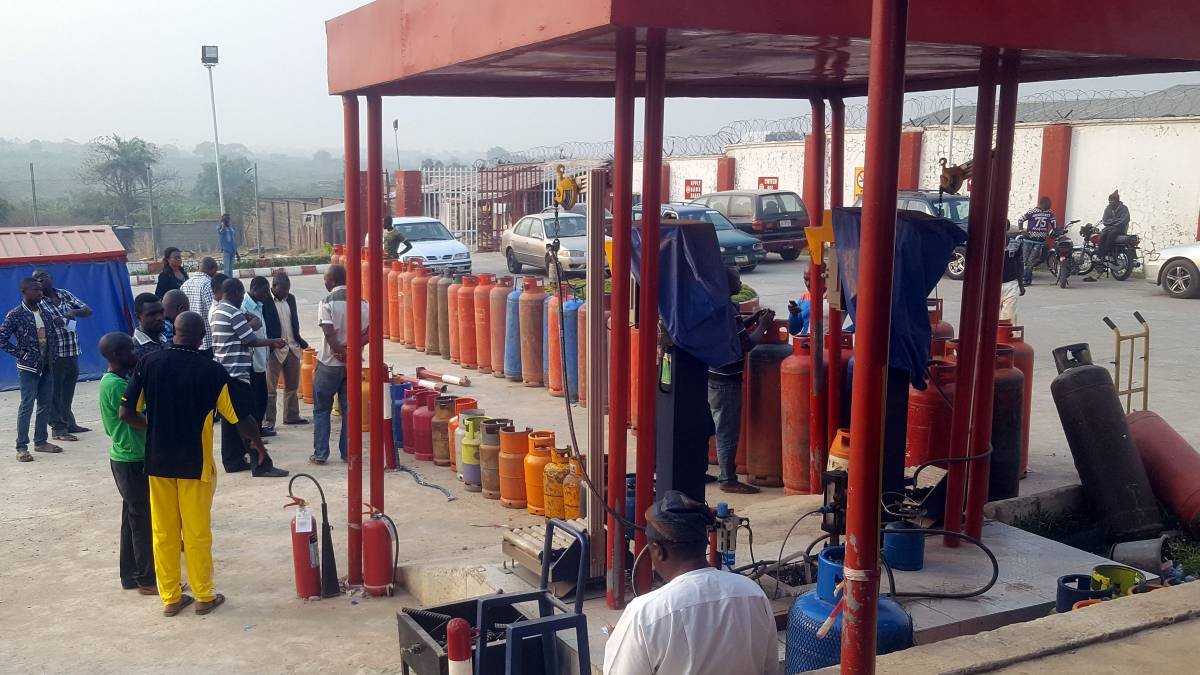
Millions of Nigerians are facing renewed economic pressure following a sharp increase in the price of cooking gas, a development that has further strained household budgets amid the country’s rising cost-of-living crisis.
The surge, which became more pronounced in the last two weeks of May, coincided with preparations for the Eid al-Kabir celebrations, leaving many families struggling to afford a basic necessity.
Earlier this year, cooking gas sold for about N1,050 per kilogramme. However, the price has now climbed to between N2,000 and N2,200 per kilogramme in many parts of the country. As a result, refilling a standard 12.5kg cylinder now costs more than N25,000, placing clean cooking energy beyond the reach of many low-income households.
The development has sparked concerns, particularly given Nigeria’s vast natural gas reserves. According to the Morocco-based Policy Center for the New South, Nigeria ranks ninth globally with gas reserves estimated at 210.54 trillion cubic feet.
Despite these abundant resources, the country continues to rely heavily on imports for nearly half of its cooking gas needs, leaving consumers vulnerable to supply disruptions, foreign exchange fluctuations and rising global energy prices.
Data from the Nigerian Midstream and Downstream Petroleum Regulatory Authority indicate that local cooking gas supply ranges between 3,300 and 4,500 tonnes daily. Yet, prices continue to rise amid growing fears of supply shortages.
Industry stakeholders warn that prolonged high prices could force many households back to traditional fuels such as firewood, charcoal and kerosene, reversing years of progress in the adoption of cleaner energy sources.
The implications extend beyond household finances. According to reports by the Voice of Nigeria, more than 160 million Nigerians still lack access to clean cooking solutions. Millions depend on traditional fuels that contribute to indoor air pollution and related health complications.
Experts estimate that between 80,000 and 95,000 Nigerians die prematurely each year from illnesses linked to exposure to harmful cooking smoke, making clean energy access a critical public health issue.
Industry operators trace the current challenges to supply disruptions that emerged in October 2025 following disagreements involving the Dangote Petroleum Refinery and the Petroleum and Natural Gas Senior Staff Association of Nigeria, which affected operations across parts of the oil and gas sector.
The Nigerian Association of Liquefied Petroleum Gas Marketers (NALPGAM) had previously warned of worsening supply conditions and escalating costs. The association disclosed that marketers currently pay between N25.2 million and N26.2 million for 20 metric tonnes of LPG, depending on location.
NALPGAM President Edu Inyang and Executive Secretary Bassey Essien described the situation as unfortunate, warning that sustained price increases could fuel food inflation, threaten small LPG businesses, discourage investment and undermine Nigeria’s clean-energy targets.
Analysts also point to international factors, including rising global energy prices, geopolitical tensions and disruptions in global supply chains, as contributors to the increase. However, they argue that Nigeria’s continued dependence on imported LPG remains a major structural challenge.
Most imported cooking gas arrives through Lagos ports before being transported across the country by road, creating additional logistics costs driven by poor infrastructure, traffic congestion, insecurity and high diesel prices.
Although the Federal Government’s National LPG Expansion and Implementation Plan projected billions of dollars in investments for production and distribution infrastructure, stakeholders say implementation has been too slow to protect consumers from recurring price shocks.
Experts have called on the government to boost domestic LPG production, strengthen local supply obligations for producers, expand storage facilities across the country and reduce regulatory bottlenecks that increase costs.
They also advocate greater investment in marine transportation, cylinder manufacturing, bottling plants and regional distribution hubs to improve efficiency and lower prices.
With food, petrol, diesel and electricity costs already placing significant pressure on households, many Nigerians are urging authorities to take urgent action to ensure cooking gas remains affordable and accessible.