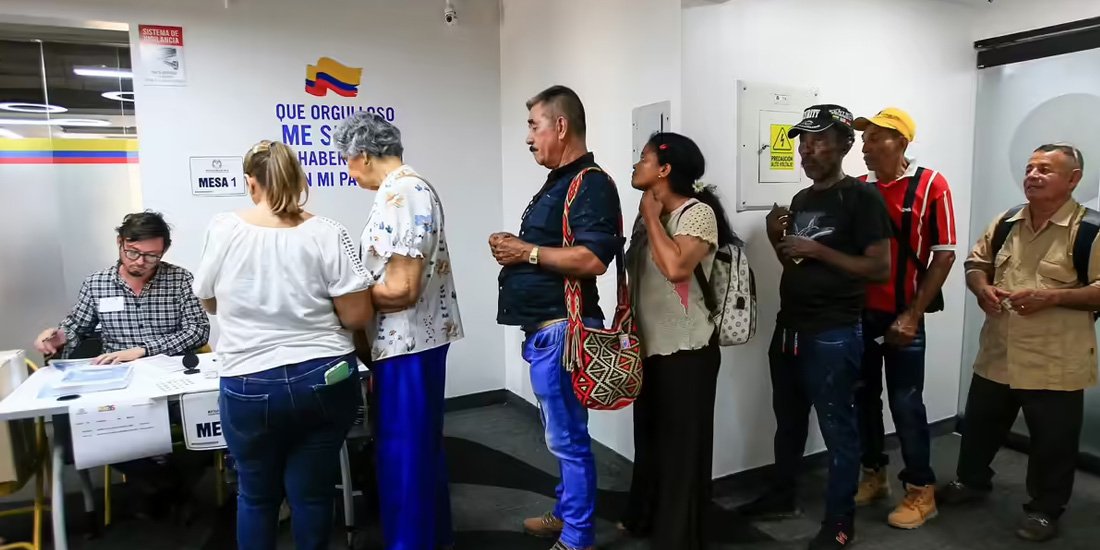
Colombians went to the polls on Sunday in a closely watched presidential election that could reshape the country’s approach to rising guerrilla violence, with voters choosing between continuing peace negotiations or adopting a tougher military response to armed groups.
Early polling showed left-wing senator Iván Cepeda leading the race, though he faced a strong challenge from hard-right lawyer Abelardo de la Espriella, a pro-Trump outsider whose campaign has centred on a forceful crackdown on criminal organisations.
The election is widely seen as a referendum on Colombia’s first leftist administration and its “total peace” strategy, which prioritised dialogue with dissident armed groups. Critics argue the approach has allowed guerrilla factions to consolidate power and expand illicit activities, including cocaine production.
The campaign period was marred by violence, including car bombings, drone attacks, and the assassination of a prominent presidential candidate, heightening national concerns over security.
De la Espriella, who brands himself “The Tiger,” has promised an uncompromising approach to armed groups, pledging to confront them “in the air, on land and at sea.” He described the election as “the most important battle in the republic’s history,” insisting he could win outright and avoid a runoff expected on June 21.
“This government really strengthened armed groups by being so soft,” said Catalina Devia, a 42-year-old voter in Bogotá, who said she might consider leaving the country if Cepeda wins.
Incumbent President Gustavo Petro, constitutionally barred from seeking re-election, has endorsed Cepeda. The senator, son of a slain former lawmaker killed by right-wing paramilitaries, has drawn support from Petro’s social reforms, including wage increases, expanded labour protections and land redistribution.
“I like the direction the Petro government took,” said Pedro Barragán, a teacher in Bogotá. “We’ve made progress in education, social justice and human rights.”
Whoever wins will inherit a deeply complex security landscape involving multiple armed groups engaged in drug trafficking, illegal mining and extortion. Colombia remains the world’s largest cocaine producer, and drug-related violence continues to fuel instability in several regions.
De la Espriella has aligned himself with the hardline approaches of leaders such as El Salvador’s Nayib Bukele and Argentina’s Javier Milei, pledging prison or death for criminal organisations. Conservative senator Paloma Valencia, another leading contender, has also supported a more militarised security strategy while appealing to centrist and female voters.
“What Colombia needs is calm and education, nothing more,” said María Juliana Duque, a Valencia supporter in Bogotá, dismissing both leading candidates as “extremes.”
Voting was scheduled to close after eight hours at 4:00 pm local time (2100 GMT), with preliminary results expected later in the evening. Despite security concerns, officials said election day remained largely peaceful, with more than 400,000 security personnel deployed nationwide.
In recent years, Colombia has experienced a resurgence of violence in rural and rebel-controlled regions. A highway bombing in Cauca last April killed 21 people, while the assassination of a right-wing presidential candidate last year deepened fears of a return to past conflicts.
“The next president needs to give us peace of mind,” said María Eugenia Motato, a resident of Cauca. “There is too much conflict, and people are living in fear.”