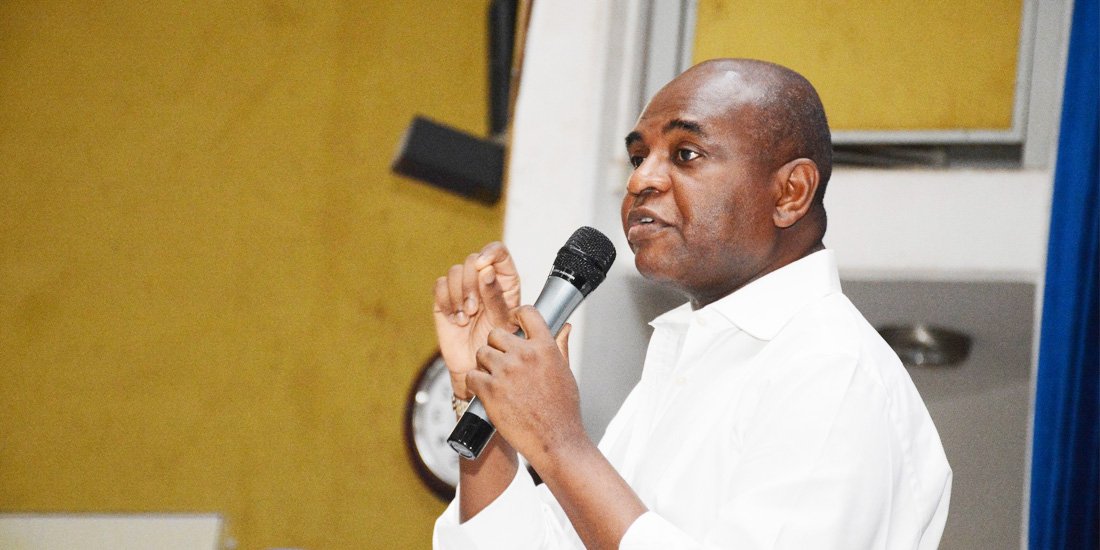
Former Central Bank of Nigeria Deputy Governor and governance scholar Kingsley Moghalu has delivered a pointed challenge to African governments, arguing that the pursuit of economic growth without first building strong institutions produces fragile economies characterized by inequality, instability, and declining public trust.
Speaking as keynote presenter at the 2026 International Civil Service Conference in Abuja, Moghalu argued that governance reform was not peripheral to economic transformation but its essential foundation. He maintained that no nation could achieve sustainable prosperity without competent state institutions capable of delivering public goods, enforcing the rule of law, and administering taxation with transparency and accountability.
He was critical of the tendency among political leaders in developing countries to treat economic management as separate from governance, arguing that technocrats could not revive economies where political systems systematically undermined institutions through patronage, ethnic balancing, and short-term electoral calculations.
On taxation, Moghalu drew a clear distinction between tax systems that fund visible public goods and those that finance what he termed elite consumption. He argued that citizens would only sustain their compliance and confidence in the state when they could see tangible developmental returns from the revenues collected. Without this connection, the social contract between citizens and government frays irreparably.
Moghalu used Nigeria as a case study in economic paradox, describing a country where banks and large corporations report trillions of naira in profits while the broader population remains poor. He noted that Nigeria’s per capita GDP, projected at approximately 1,556 dollars in 2026, placed the country among the lower income brackets globally despite the size of its nominal economy. He attributed this partly to uncontrolled population growth and persistent currency depreciation.
He contrasted Nigeria’s trajectory with that of Malaysia, Indonesia, Botswana, Singapore, and South Korea, all of which he said achieved structural transformation through policy stability, human capital investment, and effective governance. Drawing specifically on the experience of Singapore under Lee Kuan Yew, he described how a poor, corruption-ridden city-state became a developed economy through meritocracy, anti-corruption reform, and sustained investment in education and infrastructure.
On Nigeria’s security challenges, Moghalu argued that terrorism in the northeast, banditry in the northwest, separatist agitation in the southeast, and violence in the Middle Belt were not primarily military problems but symptoms of weak state presence, corruption, and the failure to deliver basic services to excluded populations. He said resource mismanagement in the Niger Delta had bred militancy, and that political interference in the civil service had eroded investor confidence by producing inconsistent policies.
His recommendations included merit-based civil service recruitment, continuous training, competitive compensation, stronger anti-corruption enforcement, and greater investment in human capital development. He urged civil servants to embrace integrity, professionalism, and results-oriented leadership, saying the future of Nigeria and Africa depended on rebuilding state capacity and restoring public trust in institutions.