Former Kano State Governor and immediate past APC National Chairman, Dr. Abdullahi Ganduje, has issued a stark warning that the systematic neglect of persons with disabilities across northern Nigeria had produced a visible and growing population of beggars sleeping under bridges and on roadsides, calling on governors, development partners, and philanthropists to invest meaningfully in disability inclusion as both a moral imperative and a practical solution to one of the region’s most persistent social crises.
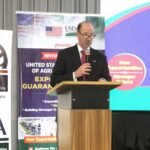
Ganduje made the call at the 10th anniversary celebration of Let’s Talk Humanity, an organisation dedicated to the education and empowerment of deaf and blind individuals, held in Abuja. He described what he had witnessed at the event as a silent revolution that demonstrated what structured, compassionate intervention could accomplish for a population too long relegated to the margins of society.
“In the northern part of this country, people with disabilities are so much relegated to the background. That is why we have an array of beggars across the northern part of this country day and night. Some sleep under bridges, some sleep on the road. This is a sorry story, but looking at what we saw this afternoon, you can see that there is a silent revolution if what we have seen could be adopted by our executive governors, development partners and by various philanthropists,” he said.
Minister of Humanitarian Affairs, Dr. Bernard Doro, reinforced Ganduje’s message by arguing that assistive technology and inclusive design were not optional accommodations but fundamental obligations that society owed to citizens with disabilities. He stressed that inclusion needed to be built into the design of technology, education systems, and public services from the outset rather than treated as an afterthought requiring costly and often inadequate retrofitting.
“Inclusion is not an option, it is not an act at all, it is a design imperative. When we design assistive devices or develop technology in general, this has to be done with people living with disabilities in mind at the design stage,” Doro said, arguing that technology designed for people at the margins of ability invariably produced better tools for everyone.
Founder of Let’s Talk Humanity, Fatima Ganduje-Ajimobi, described the occasion as deeply personal, noting that the organisation had grown from a quiet vision into a measurable force for change. She revealed a 500 percent increase in tertiary institution enrolment from Tundu Maliki Special School in Kano, describing the figure not as a hope but as hard evidence of what the organisation’s model had achieved.
She disclosed that the school was producing over 1,000 students annually across primary, junior secondary, and senior secondary levels, and argued that the ICT-centred educational model the organisation had developed represented a proven alternative to the almajiri system that had failed to provide genuine opportunity and dignity to generations of young northerners.