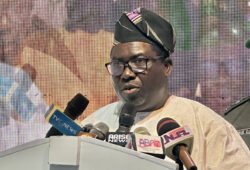
Presidential candidate of the Accord Party, Dr Gbenga Olawepo-Hashim, has said petrol could sell at about ₦605 per litre under an Accord administration and eventually fall to between ₦200 and ₦300, if Nigeria addresses production costs and exchange-rate instability.
Hashim described ₦605 as a “starting sustainable price,” insisting that the proposed reduction would not require a return to an opaque subsidy regime or reduce government revenue.
According to him, Nigeria must first establish the actual cost of producing, refining, transporting and distributing petrol before determining whether the government is genuinely subsidising consumers.
He criticised previous approaches to petroleum pricing, describing the justification for subsidy removal as “accounting magic” and calling for an independent forensic audit of the petroleum value chain.
Hashim said the audit should cover crude production, refining, contracting, transportation, storage, insurance, pipeline operations and distribution.
“Show Nigerians the books. Publish the production cost. Publish refinery cost. Publish transportation. Publish insurance. Publish every margin. Let the data speak,” he said.
The Accord candidate argued that Nigerians should not bear the cost of inefficiencies, inflated contracts, insecurity and operational weaknesses in the petroleum sector through higher pump prices.
He identified production costs and the exchange rate as key factors that must be addressed to achieve lower petrol prices, saying his proposed administration would target an exchange rate of between ₦525 and ₦700 to the dollar.
Hashim maintained that cheaper petrol should not come at the expense of government revenue or allocations to the states.
“We are not going to make petrol cheaper by making government poorer,” he said.
He argued that lower energy costs would boost manufacturing, reduce transportation expenses, increase household purchasing power and stimulate economic activity, ultimately strengthening government revenue.
Hashim also called for accelerated domestic refining, greater transparency in the petroleum industry and measures to eliminate waste and leakages.
He said government intervention in the petroleum sector was not inherently wrong but should be transparent, targeted and designed to produce measurable economic benefits.
“The issue is not whether government can intervene. The issue is whether government intervention is transparent, productive and accountable,” he said.
Hashim said the 2027 presidential election should focus on competing economic policies rather than personalities, insisting that Nigeria could achieve both affordable petrol and sustainable government revenue by addressing the underlying costs within the petroleum value chain.