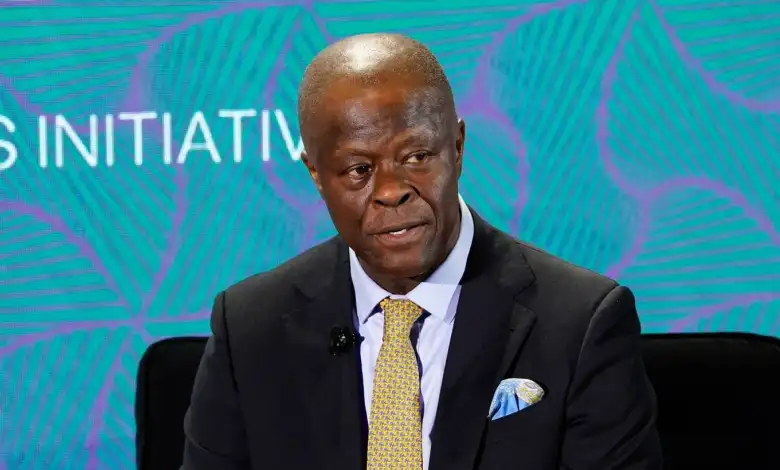
Nigeria’s Finance Minister Wale Edun has firmly ruled out any plans to seek emergency financial support from the International Monetary Fund, signalling that the government will rely on its ongoing domestic reform programme to weather growing global economic turbulence.
Edun made the declaration at the African Finance Ministers’ press briefing held on the sidelines of the IMF and World Bank Spring Meetings in Washington, D.C., even as the Fund disclosed preparations for a potential $50 billion support package aimed at cushioning vulnerable economies from the fallout of escalating Middle East tensions.
“Nigeria has no plans at the moment to approach the IMF or any other such body,” Edun said plainly.
While distancing Nigeria from any bailout arrangement, the minister called for faster and more coordinated financial support for other African economies, stressing that whatever funds are released should reach the continent quickly and at scale, given that African nations represent some of the most exposed economies globally.
Edun credited Nigeria’s two-year reform programme with restoring policy credibility and building the resilience needed to absorb external shocks. Central to that resilience, he said, was a deliberate shift toward market-based pricing of key commodities, including foreign exchange and petroleum products, rather than relying on administrative controls.
Meanwhile, United Nations Deputy Secretary-General Amina Mohammed acknowledged the progress Nigeria’s reforms have generated but issued a pointed warning: widening inequality and persistent food insecurity risk unravelling those gains unless government action at every tier becomes more coordinated and effective.
Speaking on the sidelines of the same meetings, Mohammed linked Nigeria’s domestic food challenges to broader global shocks, including conflicts in the Middle East, the Sahel, and Sudan. She called particular attention to the risk posed to upcoming agricultural planting seasons, praising the role of the Dangote fertiliser plant in helping buffer supply disruptions.
“Shore up the policies, make sure that we are working better together through the three tiers of government, because that is where delivery actually happens,” she urged.
The IMF itself weighed in on Nigeria’s situation, warning that limited fiscal space was constraining the country’s ability to respond adequately to surging food prices. IMF African Department Director Abebe Aemro Selassie pointed to transport costs as a key transmission channel, noting that rising logistics expenses were rapidly feeding through into higher food prices for households in both urban and rural areas.
He acknowledged, however, that Nigeria’s recent efforts to stabilise debt and narrow its fiscal deficit had created some buffer. “That stabilisation helps now when another shock like this comes, because there is a little bit more scope to try and defray the impact on people’s livelihoods,” he said.
On debt management, IMF Deputy African Director Amadou Sy flagged uneven progress within the African Continental Free Trade Area framework, identifying unresolved negotiations on rules of origin and tariff concessions as key factors limiting the bloc’s effectiveness as a buffer against external shocks.