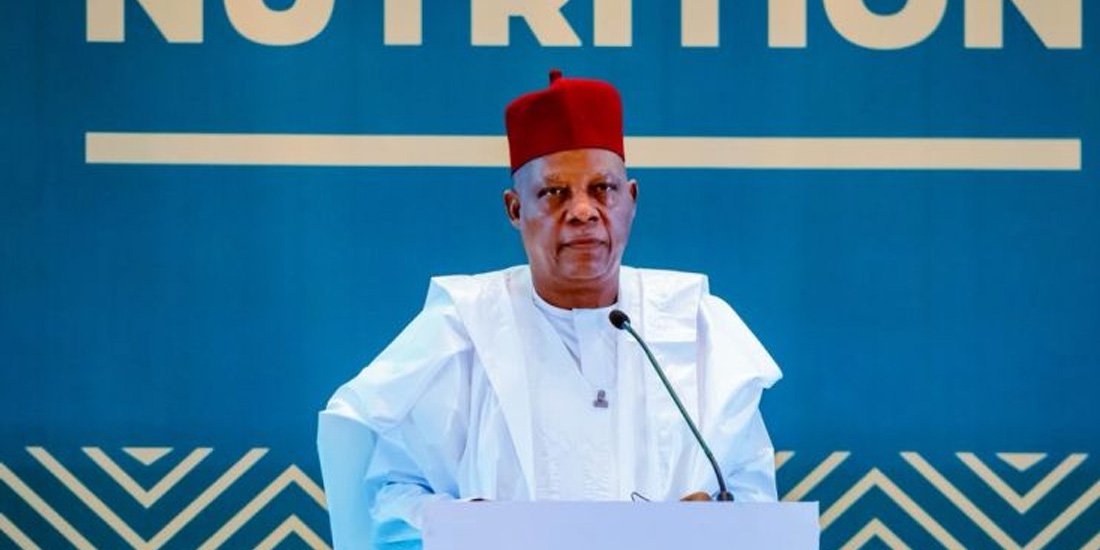
Vice President Kashim Shettima has called for drug control to be treated as a national emergency, warning that Nigeria cannot secure its future without decisive action against drug abuse, trafficking and the networks that fund them.
Speaking through Dr Modibbo Aliyu Umar, Special Adviser to the President on Special Duties, at the launch of the National Drug Control Master Plan 2026 to 2030 in Abuja on Monday, Shettima said the problem had grown beyond law enforcement into a crisis of public health, security, development and the economy. “A nation cannot secure its future if it fails to protect the people who must build that future,” he said.
He urged governments at every level, security agencies, health institutions, the courts, businesses and community leaders to move from declarations to action. The plan rests on six pillars: cutting the supply of drugs, reducing demand, ensuring access to controlled medicines for medical and scientific use, creating alternative livelihoods, disrupting the illicit drug economy, and strengthening governance, financing and coordination.
Shettima said the response must be firm with traffickers but compassionate towards people with substance use disorders. Without funding, measurable targets, reliable data and monitoring, he warned, the plan could become “a declaration of good intentions”. He praised the National Drug Law Enforcement Agency (NDLEA), led by Brig. Gen. Buba Marwa (retd.), for an alternative development pilot that is helping three communities in Ondo State replace illicit cultivation with legitimate farming.
Marwa said an evaluation of the 2021 to 2025 plan recorded more than 77,700 arrests, over 14,200 convictions and seizures of more than 14.8 million kilograms of drugs, while over 32,400 people received treatment, counseling, or rehabilitation. The review also exposed weaknesses in coordination, funding, data and monitoring, especially at state and local levels.
He said traffickers were increasingly using encrypted messaging, cryptocurrency and digital platforms, making intelligence work and financial scrutiny essential. He cited an April 28, 2026 operation with the US Drug Enforcement Administration and partners in Switzerland, France and Greece, which led to the arrest of alleged drug baron Amadi Simon in Switzerland and of two alleged female kingpins, Jecinta Amara Ikechi in Anambra and Blessing Ngozi Amadi in Delta. Bank accounts and cryptocurrency wallets were frozen, and the agency obtained interim forfeiture of properties linked to Simon, including two hotels in Delta and an apartment building in Mabushi, Abuja.
Marwa also recalled the dismantling of a methamphetamine network run by Nigerians and Mexicans, including a secret laboratory in Ogun State holding drugs and chemicals worth about $362.9 million, and the later discovery of four more laboratories in Oyo, Ebonyi and Enugu. Ten Mexicans and 14 Nigerians are facing charges. “Policy priority without resources is merely an aspiration,” he said, calling for the plan to be built into annual budgets. He also welcomed President Tinubu’s transmission of the NDLEA Bill 2026 to the National Assembly, where it has passed second reading.
Attorney General of the Federation and Minister of Justice, Prince Lateef Fagbemi, SAN, said his ministry would work with the agency and the courts to speed up prosecutions and improve asset forfeiture, extradition and the recovery of criminal proceeds across borders. He stressed that traffickers must face the full weight of the law, while people dependent on drugs need treatment and reintegration. ECOWAS, the House of Representatives Committee on Drugs and Narcotics and the First Lady of Yobe State, Hajiya Hafsat Kollere Buni, also pledged support.