
The National Universities Commission (NUC) has agreed to help the Independent National Electoral Commission (INEC) recruit credible academics for election duty and to adjust university calendars around the 2027 polls.
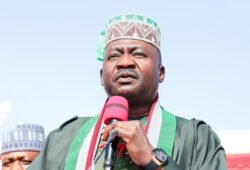
NUC Executive Secretary, Prof. Abdullahi Ribadu, gave the commitment on Monday in Abuja when INEC Chairman, Prof. Joash Amupitan, paid him a courtesy visit with national commissioners and senior officials.
Amupitan described the visit as a strategic partnership in the final stretch before the Presidential and National Assembly elections on Saturday, January 16, 2027, and the Governorship and State Houses of Assembly elections on Saturday, February 6, 2027. He noted that university staff have for more than a decade been the backbone of result collation, with Vice Chancellors serving as collation and returning officers across the country.
The chairman outlined reforms meant to make the work of academic staff safer and less contentious. Polling unit results on Form EC8A will be checked automatically for arithmetic errors and over-voting before they are sent to the INEC Result Viewing Portal (IReV). The commission has also bought 57,000 new Bimodal Voter Accreditation System (BVAS) devices, reducing the number of voters per device to 850, and will hold a nationwide mock accreditation and result transmission exercise in all 36 states and the Federal Capital Territory on Saturday, November 28, 2026. On security, the Inter Agency Consultative Committee on Election Security now operates in every local government and registration area, with dedicated security cordons and escorts around collation centers.
He cited Sections 96 and 97 of the Electoral Act 2026, which make violence, abusive language and threats against election officials criminal offences, and Section 148, which empowers the commission to prosecute offenders directly. “No Returning Officer or Collation Officer will be left to stand alone against lawlessness,” he said.
INEC asked the NUC for help in four areas: prompt nomination of verified nonpartisan academic staff, calendars aligned with election dates, joint voter education and efforts against disinformation on campuses, and the welfare and recognition of academics deployed for election duty.
Ribadu said the NUC would engage Vice Chancellors, including through an online meeting, and issue a circular to universities once INEC sends a formal letter. He said all ad hoc staff should take an oath of neutrality. Since the entire election cycle would last no more than four weeks, he suggested universities could take a break of three to four weeks without disrupting students’ studies. Students, he added, could also support voter education through campus clubs.
Separately, INEC dismissed as false social media claims that Nigerians could vote in 2027 without their Permanent Voter Cards. National Commissioner and Chairman of the Information and Voter Education Committee, Mohammed Haruna, said the claims were spreading on X, largely from anonymous accounts.
Speaking through the Deputy Director of Information and Publicity, Wilfred Ifogah, at a forum with journalists and media executives in Abuja, Haruna said Section 47(1) of the Electoral Act 2026 requires every voter to present a valid PVC at the polling unit where they registered. The BVAS verifies the card and the holder’s biometrics, he explained, but does not replace the card. “No PVC, no accreditation; no accreditation, no ballot paper,” he said, warning that anyone who believed the falsehood could end up disenfranchised.
Haruna also expressed concern about growing hostility in political speech ahead of the polls, including threats against opponents and sweeping attacks on electoral institutions and staff. He singled out the slogan “rig and die”, saying any phrase that ties an electoral offence to death is dangerous, whatever its authors claim to mean.
INEC Picks 17,656 Polling Units for Nationwide BVAS Test
INEC will test its Bimodal Voter Accreditation System in 17,656 polling units on Saturday, November 28, 2026, as part of its preparations for the 2027 general election.
In a post on X, the commission said the mock accreditation and result upload exercise would run from 8:30am to 2:30pm in two polling units in each of the country’s 8,838 registration areas.
The exercise is designed to confirm that the BVAS devices work properly, review accreditation procedures and expose any technical problems before voting begins.