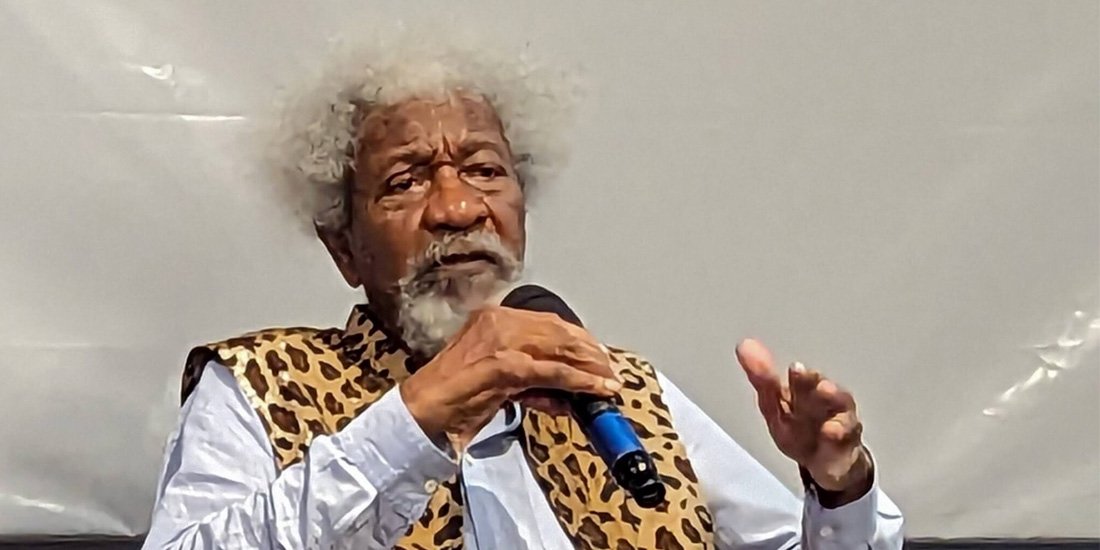
Nobel laureate, Professor Wole Soyinka, has warned scientists and technology developers against allowing artificial intelligence (AI) to undermine human creativity, imagination and identity, urging them to establish ethical boundaries that preserve humanity amid rapid technological advancement.
Soyinka gave the warning at the 2026 Nigerian Prize Awards Night organised by Nigeria Liquefied Natural Gas Limited (NLNG) in Lagos, where the theme was Heritage.
The renowned playwright acknowledged AI’s enormous potential to advance human progress but cautioned that excessive dependence on the technology could weaken people’s capacity for independent thinking and creative expression.
“The menace that AI constitutes, despite the fascination with this incredible facilitator for human progress, the menace is a very real one,” he said.
Soyinka expressed particular concern about the growing use of AI to produce academic theses, poetry and other creative works, arguing that such dependence could gradually diminish the human imagination.
“When AI begins to write our thesis, to write our poetry, or to claim that they are writing our poetry for us, there’s danger. That means we’re being dehumanised,” he said.
“We’re allowing our imagination to atrophy,” he added.
The Nobel laureate also warned about the possibility of AI generating digital replicas of writers and other creative professionals capable of mimicking their personalities, gestures and styles, raising concerns about authenticity and the preservation of human identity.
“When you begin to see a clone of a writer, a clone of the prize winner, on the internet, masquerading, imitating gestures which you thought could only be made by human beings, then there’s a real problem,” he said.
However, Soyinka clarified that his position was not a rejection of technological advancement but a call for responsible innovation that places human interests at its centre.
“Machines cannot create for us. They can create, they can measure, but they cannot replace humanity,” he said.
He urged scientists, physicists and technologists to work more closely with scholars in the humanities to ensure that the development and application of AI were guided by ethical considerations and an appreciation of human creativity.
“So, I appeal to all of you, please humanise machines. Not let machines machinise humanity,” he said.
Soyinka also appealed to NLNG to consider introducing a special consolation prize to recognise and protect human creativity in the face of AI’s growing influence.
He maintained that imagination was indispensable not only to literature and the arts but also to scientific research, noting that scientific discoveries required the ability to interpret facts, develop theories and envision possibilities.
According to him, the relationship between science and the humanities should be built on mutual respect and collaboration, with both disciplines contributing to solutions for emerging societal challenges.
He commended NLNG for using its awards to bring together literary, scientific and creative communities, describing the initiative as an opportunity to encourage interdisciplinary collaboration and expand the boundaries of human imagination.
Earlier, NLNG Managing Director and Chief Executive Officer, Adeleye Falade, said the company’s awards had become important platforms for promoting excellence in Nigeria’s literary and scientific communities.
Falade said the theme, Heritage, underscored the importance of preserving the nation’s achievements, strengthening its values and creating opportunities for future generations.
“Heritage is not merely a record of our past. It is the legacy we preserve, strengthen and pass on. It is reflected in the values we uphold, the achievements we celebrate and the opportunities that we create for future generations,” he said.
He explained that the Nigerian Prize for Science and Innovation had recognised contributions in critical areas, including healthcare, agriculture, engineering, energy, technology, climate resilience and sustainable development.
According to him, the prize celebrates researchers whose work extends beyond laboratories and academic publications to provide practical solutions capable of improving lives.
Falade said this year’s science prize-winning work, which focuses on artificial intelligence and information technology, had the potential to make a significant impact in Nigeria and internationally.
He also described the Nigerian Prize for Literature as one of Africa’s leading literary honours, providing a platform for outstanding writers to contribute to global conversations on identity, resilience and shared humanity.
The NLNG chief executive further highlighted the Nigerian Prize for Creative Arts, which was presented for the first time at the ceremony following its launch in the previous year.
He said the prize was designed to recognise originality, authenticity and creative excellence across music, film, visual arts, fashion and theatre.
According to Falade, the initiative would celebrate artists who preserve Nigeria’s cultural heritage while reinterpreting it for new generations.
“From Lagos to London, from Abuja to Atlanta, from Port Harcourt to Paris, Nigerian creativity speaks a language the world understands,” he said.
Falade congratulated the finalists and winners, describing their achievements as products of discipline, dedication and perseverance.
He reaffirmed NLNG’s commitment to supporting initiatives that promote talent, innovation and Nigeria’s contributions to global literary, scientific and creative communities.
The awards ceremony attracted diplomats, government officials, industry leaders, academics, scientists, writers, creative professionals, judges and previous laureates.