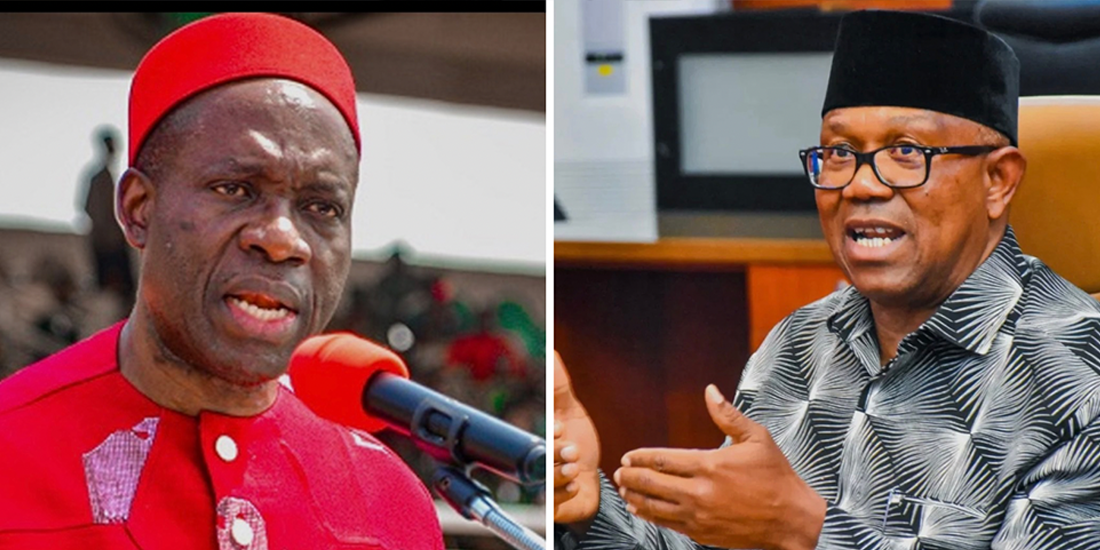
By reducing the political choices of Ndigbo to a scramble for federal patronage, Governor Charles Soludo is diminishing the dignity of his office and insulting the intelligence of the electorate.
There is a point at which political criticism stops contributing to public debate and starts to look like an obsession. Governor Charles Soludo appears to have reached that point in his repeated attacks on Peter Obi.
At a recent political gathering in Anambra State, Soludo reportedly asked, “What has he brought for the Igbos?” He accused Obi of exploiting the emotions of the Igbo people during elections and suggested that supporting him again in 2027 would amount to wasting their votes. He then advanced the troubling argument that the South East must align with those at the centre so the region can “take our share.” Those remarks were not a serious interrogation of Peter Obi’s record. They were a cynical appeal to fear, patronage and political surrender, one that reduced the democratic rights of millions of people to a crude calculation about who controls the sharing table in Abuja.
None of this is to say Obi is above criticism. No politician is. As a former governor and presidential candidate, his record, statements, policies and promises must be subjected to rigorous scrutiny. But scrutiny requires evidence, consistency and intellectual honesty, not insinuation, ethnic pressure or endless personal attacks from a sitting governor whose first responsibility is to govern Anambra State. Soludo’s central question is itself deeply flawed. Obi served as governor of Anambra State, not as President of Nigeria or as an ethnic representative charged with distributing federal favors to every Igbo community. His years in office should be judged by what he did with the authority and resources entrusted to him in Anambra. If Soludo believes Obi failed on education, health, infrastructure, public finance, security or job creation, he should publish the evidence and invite an honest comparison.
What he should not do is pretend that leadership is measured by how much political patronage a politician brings to an ethnic group. That is the very philosophy that has weakened Nigeria for decades. Public resources are not the private meat of victorious hunters. Federal projects and national opportunities are not gifts reserved for communities that vote for the governing party. They belong to Nigerians by right. The suggestion that Ndigbo must support the ruling establishment to receive a fair share of national resources is particularly disturbing. It normalises political exclusion and presents discrimination as a legitimate consequence of electoral choice. A governor should confront that injustice, not use it to frighten his people into submission.
A vote is not wasted simply because the preferred candidate does not win. A vote is an expression of conviction, consent and citizenship. The people of the South East are not a herd to be directed toward whichever political camp promises access to federal favour; they are citizens capable of examining the candidates and deciding what kind of country they want. Soludo is entitled to support President Bola Tinubu. Peter Obi is entitled to seek the presidency. Other Nigerians are equally entitled to reject both men. That is democracy. What is unacceptable is portraying an independent political choice as foolishness or betrayal merely because it does not align with the governor’s preferred arrangement.
The latest attack comes amid a bitter dispute over the financial record of Obi’s administration. Soludo’s government says it is servicing external obligations connected to projects initiated during Obi’s tenure. Obi insists he left no unpaid salaries, pensions, gratuities or certified contractor bills, and has challenged the state government to prove otherwise. The government has also disputed his account of a dedicated ecological fund. These competing claims should be resolved with documents, not political theatre. External loan balances, overdue salaries, contractor liabilities and dedicated funds are separate accounting questions; collapsing them into one sweeping accusation may excite partisans, but it does not establish the truth. The Soludo administration should publish the complete loan agreements, approval dates, disbursement records, repayment schedules, project accounts, bank statements and relevant audited financial reports. Obi should submit his own records to the same scrutiny. An independent reconciliation of the documents would serve Anambra far better than another round of inflammatory speeches.
Soludo’s conduct is especially disappointing because far more is expected from a man of his academic and professional standing. A professor of economics and former Governor of the Central Bank of Nigeria should elevate political argument, insisting on data, context and verifiable comparisons, rather than reduce a consequential national debate to taunts about who caught an elephant and who failed to catch a cockroach. Every fresh attack risks shrinking Soludo’s public image rather than damaging Obi’s. It creates the impression of a governor more preoccupied with his predecessor’s national profile than with letting his own record speak. If Soludo’s performance is genuinely superior, the evidence should be visible in safer communities, stronger schools, better roads, thriving markets, accountable finances and expanding opportunity. Governance cannot be built on resentment, and political relevance cannot be secured by repeatedly trying to diminish another man. The more Soludo makes Peter Obi the central subject of his public appearances, the more he invites Nigerians to ask why he seems unable to leave his predecessor alone.
Soludo must also understand that attacking the political judgment of millions of Igbo voters is not a strategy for winning their trust. People who supported Obi did so for different reasons: some admired his record, some wanted an alternative to the established order, some were dissatisfied with the leading parties, others simply believed he represented their best available choice. Soludo may disagree with them, but he has no right to treat their decision as evidence of ignorance.
If Peter Obi has lied, Soludo should prove it conclusively. If Obi left debts, the governor should present a complete and independently verifiable account. If Obi failed Anambra, Soludo should produce a fair scorecard. If Soludo has governed better, he should demonstrate it through measurable results. But the governor must stop using the prestige of his office to wage a repetitive political war. Anambra elected him to govern, not to run a permanent campaign against Peter Obi. Ndigbo need security, functioning infrastructure, jobs, quality education, responsive institutions and transparent government, not lectures about surrendering their political convictions in exchange for a place near the federal table.
Soludo’s latest outburst was beneath the dignity of his office. It substituted contempt for persuasion and patronage for principle. He should withdraw from this politics of personal hostility, publish the facts he claims to possess, and return his attention to the enormous responsibility of governing Anambra State. Peter Obi’s political future will be decided by Nigerian voters. Soludo’s legacy will be decided by what he delivers as governor. Neither verdict can be manufactured through insults.