President Bola Tinubu has called for stronger collaboration among African countries to end the long-standing exploitation of the continent’s critical mineral resources and accelerate industrial development through local value addition.
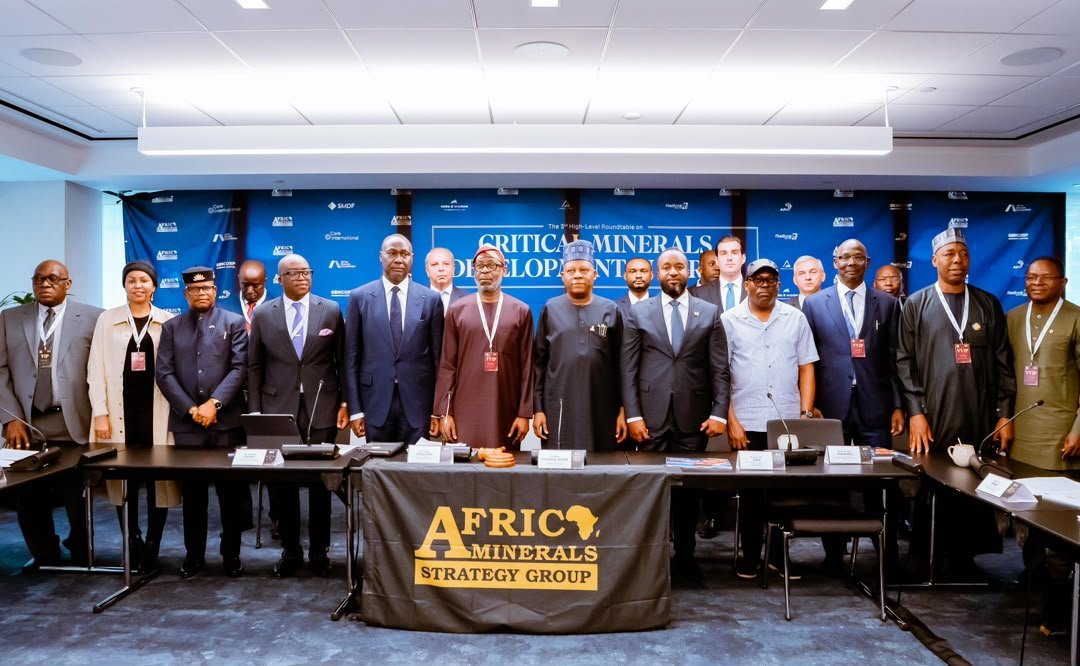
Speaking on Monday at the Africa Minerals Strategy Group (AMSG) High-Level Roundtable on Critical Minerals Development in Africa, held on the sidelines of the 81st Session of the United Nations General Assembly (UNGA) in New York, Tinubu urged African leaders to work together to ensure the continent benefits more from its vast mineral wealth.
The roundtable, convened and chaired by the Nigerian leader and attended by Vice President Kashim Shettima and Minister of Solid Minerals Development, Dr. Dele Alake, focused on transforming Africa’s mineral resources into sustainable economic prosperity.
Represented by Vice President Shettima, Tinubu lamented the continued export of raw minerals from Africa while communities hosting mining activities remain underdeveloped.
“For generations, Africa has furnished the materials of prosperity elsewhere. Our duty is to ensure that the future being fashioned from African minerals has room for African ambition,” the President said.
He stressed that Africa cannot claim to be wealthy while millions of its citizens remain poor despite the abundance of natural resources beneath their soil.
Tinubu noted that the global demand for critical minerals such as lithium, cobalt, copper and rare earth elements, driven by clean energy technologies, artificial intelligence and advanced manufacturing, presents a unique opportunity for Africa to reposition itself within global supply chains.
According to him, the continent must shift its focus from merely extracting and exporting minerals to developing local processing plants, refineries, battery manufacturing facilities and technology-driven industries that create jobs and generate long-term wealth.
“The worth of a mine must be counted in the lives it improves. Jobs, industries, infrastructure, technology transfer, African enterprise participation and prosperity retained across generations must measure our progress from resources to wealth,” he said.
The President warned that African nations would weaken their bargaining power if they continue to compete against one another through lower royalties, excessive concessions and weaker local content policies.
“Fragmentation leaves us exporting raw materials and buying finished goods at a premium. Cooperation gives our markets scale, our industries integration, our financing reach and our negotiations authority,” he stated.
Highlighting reforms in Nigeria’s mining sector, Tinubu said his administration has prioritised local value addition, improved geological data access, strengthened regulation, organised artisanal miners into cooperatives and intensified efforts against illegal mining.
He disclosed that government revenue from the mining sector increased from about ₦6 billion in 2023 to over ₦38 billion in 2024, and is projected to rise to between ₦68.1 billion and ₦70 billion in 2025.
The President also pointed to major foreign investment commitments and the establishment of large-scale lithium processing facilities in Nasarawa State as evidence that Nigeria’s mining reforms are attracting serious investors.
Tinubu urged African countries to adopt policies that ensure mineral resources support local industries, skills development and community growth while fostering mutually beneficial partnerships with international investors.
He further called on member states of the Africa Minerals Strategy Group to speak with one voice in defending the continent’s interests.
“Reliability must never mean dependency, and partnership must never demand inequality,” he said.
On the Continental Integration and Economic Assurance Declaration (CIEAD) adopted during the roundtable, Tinubu said the framework should create an investment-friendly environment for Africa’s strategic mineral corridors through harmonised policies, shared infrastructure and responsible investment practices.
He emphasised that the declaration must move beyond ceremonial endorsement and be backed by clear implementation plans, financing arrangements, timelines and accountability mechanisms.
Opening the roundtable, Tinubu reiterated the need for a coordinated continental strategy to unlock Africa’s mineral potential.
“Africa’s power resides in its people, markets and ingenuity. No outsider will organise our continent or place our industrial interests above their own. We must integrate our markets, mobilise African capital and negotiate with one voice wherever our interests converge,” he said.
Earlier, AMSG Chairman and Nigeria’s Minister of Solid Minerals Development, Dr. Dele Alake, described the proposed Continental Integration and Economic Assurance Declaration as a landmark framework designed to create a unified value chain for Africa’s critical and solid minerals sector.
Alake urged more African countries to join the AMSG, saying stronger regional cooperation is essential for unlocking the continent’s mineral wealth and accelerating industrialisation.
Also speaking at the event, Kenya’s Minister of Blue Economy and Maritime Affairs, Hassan Ali Joho, emphasised the importance of domestic resource mobilisation, transparency and improved licensing systems to drive growth in Africa’s mining sector.
Representatives from Liberia, Chad and Tanzania also contributed to discussions on strengthening cooperation and ensuring Africa derives greater economic benefits from its abundant mineral resources.