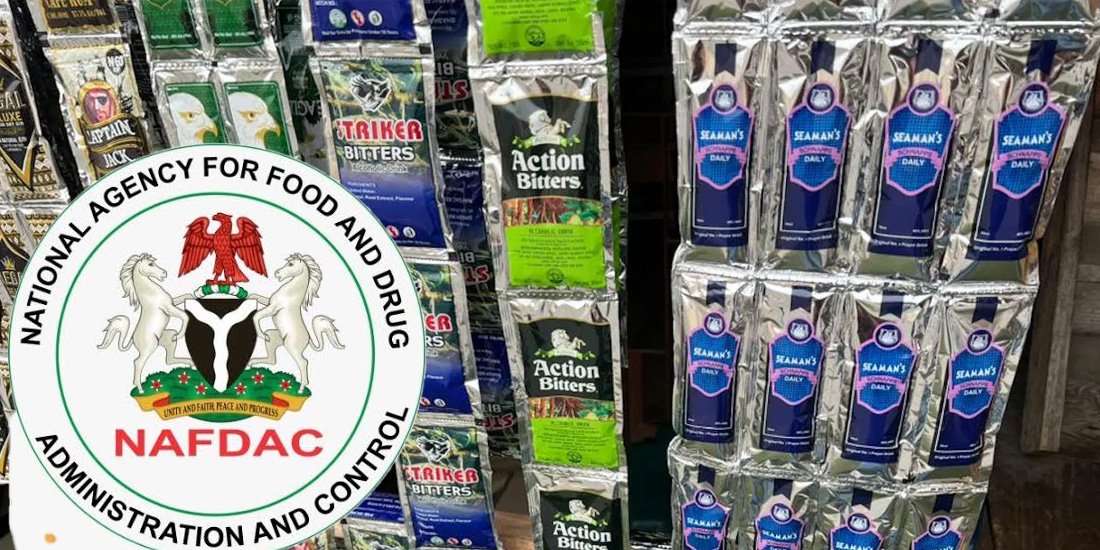
Retailers of alcoholic beverages in Lagos have intensified opposition to the enforcement of the federal restriction on sachet and small-volume alcoholic drinks, saying raids and confiscations are destroying businesses and wiping out the working capital of petty traders.
Members of the Lagos chapter of Concerned Drink Sellers and Traders Across Nigeria staged a protest and appealed to President Bola Tinubu, the National Assembly and the National Agency for Food and Drug Administration and Control to reconsider the current enforcement strategy.
The traders said repeated seizures of unsold stock had left many retailers unable to repay loans or meet basic household expenses.
They argued that sachet alcoholic beverages remained an important source of livelihood for thousands of people operating small shops and neighborhood retail outlets.
Some protesters said they had invested borrowed money in inventory that could no longer be sold or returned to suppliers.
They urged the government to consider alternatives such as stricter age controls, targeted monitoring, public education, and controlled distribution rather than blanket confiscation.
NAFDAC, however, has maintained that the restriction is a public-health measure intended to reduce harmful and underage consumption.
The agency has targeted alcoholic drinks packaged in sachets and in PET or glass containers below 200ml.
NAFDAC Director-General Mojisola Adeyeye has argued that such packaging makes alcohol cheap, easily concealed and readily accessible to young people.
Manufacturers were previously given transition periods and extensions before the final enforcement deadline expired at the end of December 2025.
The agency has therefore said stakeholders had sufficient time to adjust production and distribution.
Retailers dispute that position, insisting that the economic consequences for small traders have become severe amid wider cost-of-living pressures. The disagreement highlights the difficult balance between public-health regulation and the livelihoods of people operating in the informal economy