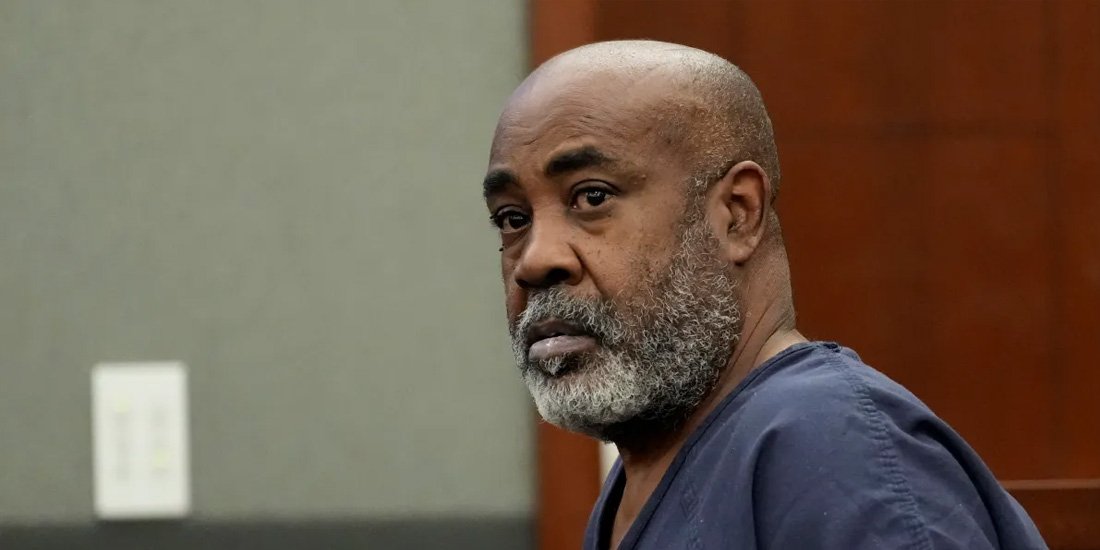
A Las Vegas jury has found former South Side Compton Crips gang leader Duane Keith “Keffe D” Davis guilty of the 1996 murder of legendary rapper Tupac Shakur, bringing a nearly three-decade-old case to a dramatic conclusion.
The jury reportedly deliberated for about three hours before reaching the guilty verdict in a case that relied heavily on statements Davis himself had made over the years about his alleged involvement in the killing.
Davis, 63, was accused of orchestrating the shooting but not being the person who pulled the trigger. He had repeatedly spoken to investigators and in interviews about his involvement before his arrest in 2023.
Prosecutors presented eight hours of recordings from four separate events in which Davis discussed what happened on the night of September 7, 1996.
They also relied on his 2019 memoir, Compton Street Legend, in which Davis described the events leading up to the shooting and claimed he was inside the vehicle from which the shots were fired.
According to the prosecution’s case, Davis helped organise the attack after Shakur’s entourage assaulted his nephew, Orlando “Baby Lane” Anderson, in the lobby of the MGM Grand earlier that evening.
Shakur and Marion “Suge” Knight, founder of Death Row Records, had attended a Mike Tyson boxing match at the casino before the altercation. They were later travelling to an after-party when a white Cadillac pulled alongside their vehicle at a red light.
Investigators said someone inside the Cadillac opened fire, striking Shakur four times.
Shakur was taken to hospital but died several days later at the age of 25.
Davis claimed in his memoir that he was inside the Cadillac and had brought a .40-calibre Glock with him. He also wrote that the confrontation involving Anderson had prompted the group to retaliate against Shakur.
Prosecutors, led by Clark County District Attorney Marc DiGiacomo and Chief Deputy District Attorney Binu Palal, called 25 witnesses during the weeks-long trial. Some witnesses were reportedly reluctant to testify and had to be compelled by the court.
Davis’s defence attorney, Michael Sanft, argued that his client’s previous accounts had been exaggerated and embellished to profit from the enormous public interest surrounding Shakur’s death and the mystery that had surrounded the case for decades.
Despite that defence, prosecutors presented Davis’s own statements as central evidence against him.
DiGiacomo argued that Davis’s decision to document his version of events ultimately helped investigators build the case.
“Had he decided to never write the book,” DiGiacomo said during the trial, “he would not, probably, have ever been prosecuted for the crime.”
The murder of Shakur, one of the most influential figures in hip-hop history, has generated decades of speculation and conspiracy theories over who was responsible and why the investigation remained unresolved for so long.
Born in 1971 in East Harlem, New York, Shakur rose to international fame in the early 1990s through music that combined poetic storytelling with commentary on racism, police brutality, poverty and social injustice.
His influence has continued long after his death, with his music and legacy inspiring generations of artists and fans around the world.
The case has also drawn criticism over alleged investigative failures in the years following the shooting. A 2015 review by the Los Angeles Times detailed claims that authorities failed to thoroughly investigate Anderson despite information linking him to the earlier confrontation with Shakur’s entourage.
Police also reportedly failed to pursue a lead from a member of Shakur’s entourage who claimed he could identify the shooters. That witness was killed in a separate shooting weeks later.
Investigators have maintained that the case was difficult to prosecute because of a lack of physical evidence and resistance from potential witnesses, including individuals connected to Shakur’s entourage.
The prolonged investigation has also fuelled concerns among some of Shakur’s relatives, fans and prominent Black figures that the case reflected broader problems within the justice system.
Zayd Akinyela, Shakur’s cousin, previously expressed the emotional toll of the decades-long wait for answers.
“We’ve been waiting 30 years to grieve properly,” Akinyela told reporters outside the courtroom.
“A lot of people don’t get to grieve until they understand what happened to their loved one and how it happened,” he added.
Following the verdict, Clark County District Court Judge Carli Kiern scheduled Davis’s sentencing for October 13. Prosecutors did not seek the death penalty and voluntarily withdrew their effort to add a gang enhancement to his conviction.
Under Nevada law, first-degree murder carries a sentence ranging from 20 years to life imprisonment.
Davis has indicated that he plans to appeal the verdict.
After nearly 30 years of unanswered questions, his conviction represents the most significant legal development in the investigation into the death of one of hip-hop’s most enduring icons.