Vice-President Kashim Shettima has said the administration of President Bola Ahmed Tinubu is deliberately expanding infrastructure and economic opportunities beyond major cities to reduce congestion, create jobs and promote balanced development across Nigeria.
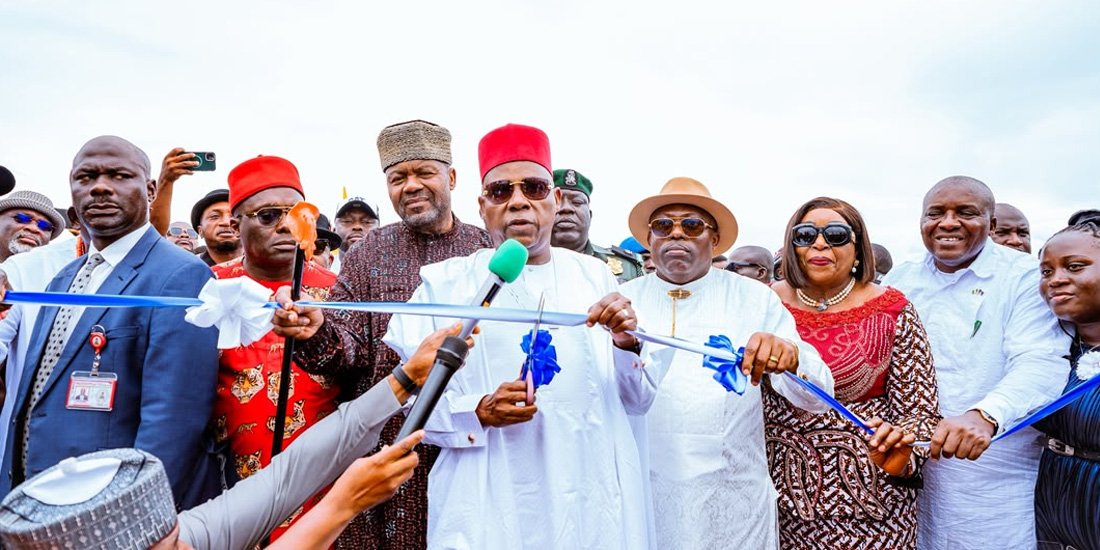
Shettima stated this on Thursday while inaugurating the 33.5-kilometre Elele-Umudioga-Egbeda-Ubimini-Akpabu-Ikiri-Omoku Dual Carriageway in Rivers State on behalf of President Tinubu.
The road passes through Ikwerre, Emohua and Ogba/Egbema/Ndoni Local Government Areas and connects communities along an important agricultural, commercial and oil and gas corridor leading to Omoku, popularly known as the state’s “Gas City.”
The Vice-President said the project was consistent with the administration’s Renewed Hope Agenda and its commitment to expanding security, welfare and economic opportunities across the country.
“A nation becomes congested when opportunity is congested. People move because roads, markets, jobs and services have not moved far enough towards them,” Shettima said.
He described roads as critical drivers of inclusive development, noting that they connect farmers to markets, workers to jobs, students to schools and patients to healthcare facilities.
“Roads are among the most democratic instruments of development. They serve the farmer carrying produce to market, the trader seeking customers, the worker travelling to employment, the student going to school and the patient seeking care. When a road works, society moves,” he said.
According to Shettima, the completed road will enable farmers to transport their produce more efficiently, reduce post-harvest losses, lower logistics costs and stimulate economic activities in communities along the corridor.
“Public infrastructure must be judged by the lives it improves. A road earns its value when a farmer earns more, a child reaches school earlier, and isolation no longer punishes enterprise,” he added.
Shettima commended Rivers State Governor Siminalayi Fubara for completing the project, describing it as an example of state-led investment that supports the objectives of the Federal Government.
He also stressed the importance of continuity in governance, saying successive administrations should build on existing projects for the benefit of citizens.
“One administration lays a foundation, another strengthens it, and the people remain the final beneficiaries,” he said.
The Vice-President urged residents along the road corridor to protect the infrastructure from vandalism, reckless use and other activities that could shorten its lifespan.
Earlier, Governor Fubara said the 33.5-kilometre road, which includes a river-crossing bridge, would improve security and ease the longstanding transportation challenges faced by residents of the three benefiting local government areas.
The governor said the corridor had previously been associated with kidnapping, oil bunkering and other criminal activities but expressed confidence that the completed road would significantly improve security.
Fubara disclosed that streetlights had been installed along the entire stretch of the road, while security agencies would increase surveillance in the area.
“In this project, we have lights from the beginning to the end. So, even in the night, insecurity is totally eliminated,” the governor said.
He thanked President Tinubu and Shettima for their support for his administration and the people of Rivers State.
Fubara also expressed his appreciation for the completion of the project, describing it as evidence that promises made to the people could be fulfilled.
The Rivers State Commissioner for Works, Prof. Temple Nwofor, said the commissioning represented another significant step in the state government’s efforts to provide durable infrastructure, improve connectivity and promote economic activities across beneficiary communities.
He said the road linking the three local government areas would enhance mobility, facilitate development and create new economic opportunities for residents.
Also speaking, the Chairman of Emohua Local Government Area, Dr Chidi Lloyd, described the project as more than a road, saying it would open up communities, ease transportation and stimulate economic activities.
He described the road as a “road to reconciliation and prosperity” that would strengthen connections among communities and improve the lives of residents along the corridor.