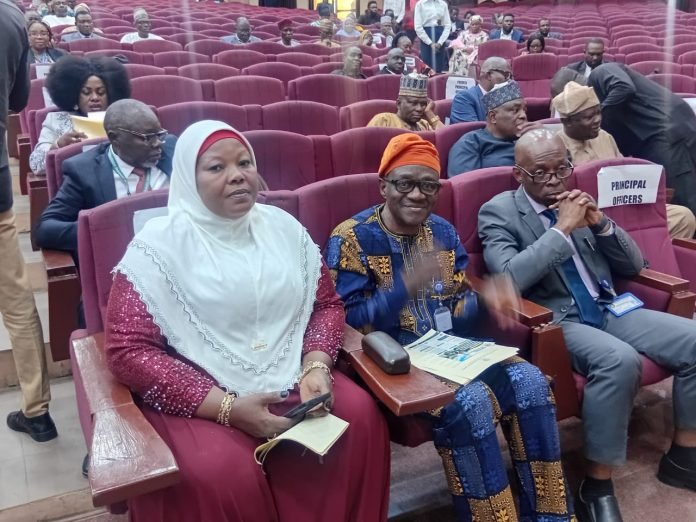
Vice chancellors from 348 Nigerian universities converged in Ilorin under the Committee of Vice Chancellors of Nigerian Universities to map out how the country’s higher education system can compete globally, at a gathering themed Building Resilient Universities for Nigeria.
President Bola Tinubu, represented by Minister of State for Education Suwaibat Saidu Ahmad, told the gathering that universities must move beyond simply awarding degrees to become engines of innovation, practical skills and national development, arguing that Nigeria cannot achieve lasting economic transformation without matching investment in human capital. He said graduates need to be not just academically capable but innovative, digitally competent, entrepreneurial and ready to solve real problems, especially as artificial intelligence, automation, biotechnology and data science reshape the global economy.
He pointed to reforms already underway through the Nigerian Education Sector Renewal Initiative, covering governance, quality assurance, research, digital transformation and stronger ties between universities and industry, and singled out agriculture as an example where curricula are shifting from roughly 70 percent theory toward 80 percent hands on practice, with accreditation rules set to require partnerships between agriculture departments and relevant industries. He said the same shift toward practical training would gradually extend to other disciplines. He also urged vice chancellors to sharpen university governance and treat research as a source of real world solutions rather than knowledge for its own sake, warning that Nigeria cannot build a competitive economy by relying mainly on knowledge produced elsewhere.
CVCNU chairman Lawrence Ikechukwu Ezemonye, vice chancellor of Igbinedion University, told delegates that Nigerian universities face a test not of survival but of relevance to a young and impatient nation, and that resilience means adapting to funding constraints, technological change, insecurity and shifting labour markets rather than merely enduring them. He said the country’s past achievements are not a guarantee of future relevance, urging institutions to rebuild themselves as innovation engines and community anchors rather than isolated ivory towers.
National Universities Commission executive secretary Abdullahi Yusufu Ribadu warned universities against abusing newly tightened rules on honorary doctorates, saying no institution should award more than three at a single convocation and that serving public officials should not receive them while still in office, with honours instead reserved for after they leave. He said violators risk sanctions including suspension of resource verification for new academic programmes, a penalty that could hit universities seeking approval for courses in fields such as artificial intelligence and robotics.
Guest speaker Is haq Oloyede, a former University of Ilorin vice chancellor and former JAMB registrar, told the conference that resilience should mean structured adaptation and disciplined renewal rather than stubborn endurance, and that no amount of infrastructure or technology can make up for weak leadership. He urged governing councils to build institutions that outlast any single office holder, with strategic plans that genuinely guide budgets, appointments and performance rather than sitting unused on a shelf.