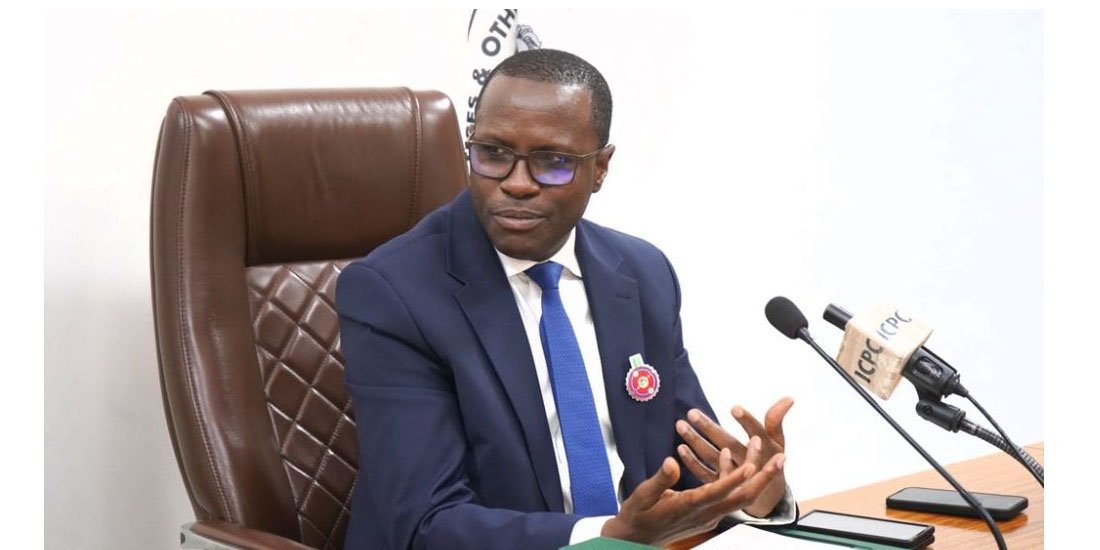
The Independent Corrupt Practices and Other Related Offences Commission has argued that Nigeria’s anti corruption campaign must increasingly focus on strengthening institutions and preventing abuse before public resources are lost.
ICPC Chairman Musa Adamu Aliyu said corruption had direct consequences for economic stability because it increased the cost of government, weakened institutions, discouraged investment and reduced public confidence.
He spoke at the Economic Confidential Lecture and National Spokespersons Awards in Abuja.
Aliyu said anti corruption policy should not be viewed only through arrests and prosecution but also through reforms capable of closing institutional loopholes.
He disclosed that the commission had uncovered payroll manipulation involving public officials who allegedly enrolled relatives as government employees.
In one case, an official was accused of placing 14 family members on the payroll.
Another person allegedly enrolled a wife, children and other relatives and received multiple salaries through the scheme.
The ICPC said about 900 suspected ghost workers had been identified during a wider investigation.
Aliyu said payroll manipulation could create additional losses through pensions, mortgages, housing benefits and health insurance tied to fictitious employees.
He said the commission recovered more than N24 billion from ghost pension related activities in 2024.
Between 2023 and June 2026, the ICPC tracked 4,582 public projects valued at more than N22.53 trillion.
The commission said its intervention helped return projects worth about N507.04 billion to construction sites and produced estimated government savings of N385.62 billion.
Aliyu also highlighted reforms including the Treasury Single Account, payroll digitisation, beneficial ownership disclosure, procurement reforms and whistleblower mechanisms.
He said artificial intelligence and digital tools could improve fraud detection, procurement monitoring and financial intelligence but warned that technology could also create new threats through cybercrime, identity theft and deepfakes.
The ICPC chairman also linked recent controversy surrounding an alleged fake federal agency to weaknesses in institutional verification.
He said public officials must carry out stronger due diligence before accepting documents or claims of official authority.
Information Minister Mohammed Idris said Nigeria’s anti corruption strategy should create systems in which accountability was embedded rather than dependent solely on the personal integrity of office holders.
He also argued that government communication should explain reforms clearly and honestly rather than operate as propaganda.
At the same event, Central Bank of Nigeria communications official Hakama Sidi Ali was named 2026 Spokesperson of the Year.