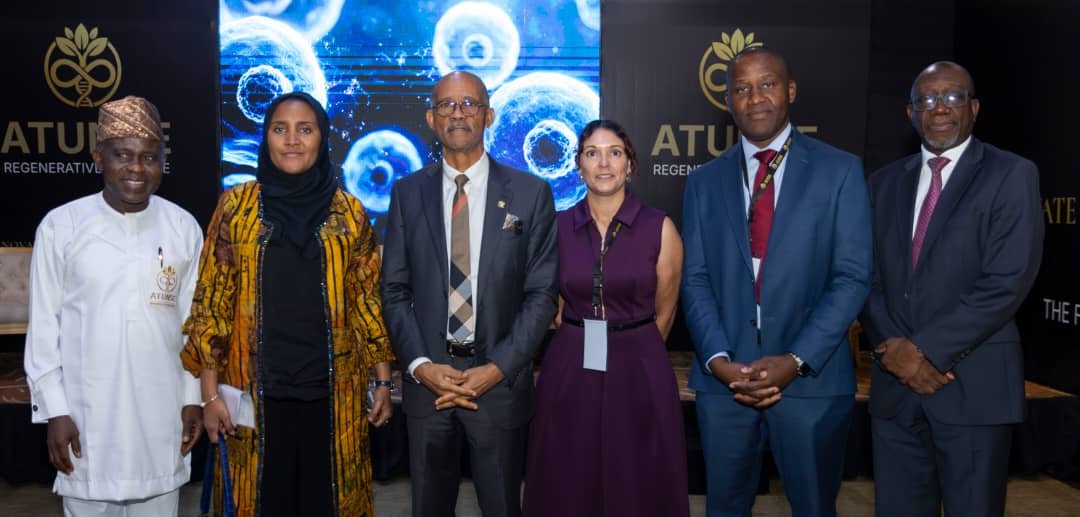
President of Dangote Group, Aliko Dangote, and Lagos State Governor, Babajide Sanwo-Olu, have backed efforts to expand Nigeria’s capacity to produce advanced medical therapies locally, saying the country must reduce its dependence on imported healthcare products and curb medical tourism.
Their positions were expressed during the launch of Atunse Healthcare in Lagos, a company focused on the manufacture and distribution of advanced regenerative biologics, as well as the training of Nigerian scientists and clinicians.
Speaking at the African Regenerative Medicine and Longevity Summit in Lagos, Dangote, represented by Fatima Aliko Dangote, Group Executive Director, Commercial Operations for Oil & Gas, Dangote Industries, said the COVID-19 pandemic exposed the risks associated with Africa’s heavy reliance on imported medical products.
“COVID-19 taught us a very important lesson: dependence is a vulnerability,” Dangote said, stressing that the pandemic showed how countries prioritised their own populations in accessing vaccines, diagnostics and essential medicines.
He said Nigeria must transition from being a consumer of advanced medical products to becoming a producer of medical technologies.
“That is why initiatives like Atunse are important. We must begin to ask ourselves: how do we move from being consumers of advanced medicine to becoming producers of it?” he said.
Dangote noted that Nigeria had the human talent, entrepreneurial capacity and market required to develop a strong medical manufacturing ecosystem, but urged greater collaboration among government, investors, scientists and private-sector operators.
He said such partnerships would help create an enabling environment for investment, innovation and large-scale production of medical technologies.
Representing Governor Sanwo-Olu at the event, Lagos State Commissioner for Health, Prof. Akin Abayomi, said the development of advanced medical facilities and manufacturing capacity could also help reverse the country’s brain drain by encouraging Nigerian medical professionals and scientists abroad to return home.
“We need our own experienced specialists back to do this. When we start seeing initiatives like this, it starts to encourage our own experienced specialists to come back home,” Abayomi said.
He described regenerative medicine as an emerging field with significant potential for Nigeria, while stressing the need to strengthen research institutions, universities and the skilled workforce required to develop the sector.
Earlier, President and Chairman of Atunse Healthcare, Prof. Kamar Adeleke, said the company was established to reduce Nigeria’s dependence on foreign countries for advanced medical treatment.
“For a generation, the most advanced medicine available has been something Nigerians travelled for — if they could afford the journey,” Adeleke said.
“Atunse was established on the position that they should not have to, and that the capability to deliver and eventually produce such medicine belongs on the continent rather than at the end of an import chain.”
Adeleke said Atunse currently provides services across six areas, including aesthetic medicine, longevity and vitality, men’s wellness, women’s wellness, musculoskeletal support and neurological care.
He said Africa imports about 99 per cent of its vaccines and more than 95 per cent of its medicines, while Nigerians reportedly spent an estimated $2.39 billion on medical treatment abroad in 2024.
According to him, the cost of medical tourism goes beyond foreign exchange outflows, as many Nigerians who cannot afford overseas treatment are also unable to access advanced medical care.
Adeleke said Atunse is a partnership between KweHealth LLC of the United States, which provides scientific and manufacturing expertise, and Nigeria’s Tri-State Healthcare System, which contributes clinical and institutional capacity.
He said the company’s long-term strategy includes clinical delivery, advanced biomanufacturing, research and clinical translation, as well as the development of local regulatory capacity.
Atunse is also working towards establishing cGMP-grade production of advanced biologics in Nigeria, with plans eventually covering vaccines, cell therapies and gene therapies.
Adeleke, however, stressed that developing manufacturing capacity without building local scientific expertise would only create another form of dependency.
“A country which manufactures without training its own scientists, and without governing its own standards, has substituted one dependency for another,” he said.
The Chief Executive Officer of Atunse Healthcare, Dr. Sola Oluwole, said Nigeria’s medical tourism challenge was costing the country financial resources as well as clinical talent and investment.
“What Nigeria loses is not only money. It is the demand, the capital and the clinical talent that need never have left,” Oluwole said.
He added that the company intended to build treatment, manufacturing, distribution and human-capital capacity locally.
Meanwhile, the Director-General of the National Agency for Food and Drug Administration and Control (NAFDAC), Prof. Mojisola Adeyeye, represented at the event by Khadijah Ade-Abolade, Director of the Vaccines, Biologics and Medical Devices Registration Directorate, pledged regulatory support for responsible innovation.
Adeyeye said NAFDAC was strengthening its regulatory framework to accommodate emerging medical technologies while ensuring that new therapies meet required standards for safety, quality and effectiveness.
She also warned against the promotion and sale of unverified or unapproved stem-cell products by wellness centres and online vendors.
The launch comes amid growing calls for Nigeria and other African countries to strengthen local pharmaceutical and medical manufacturing, reduce dependence on imports and develop healthcare systems capable of retaining patients, investment and medical expertise within the continent.