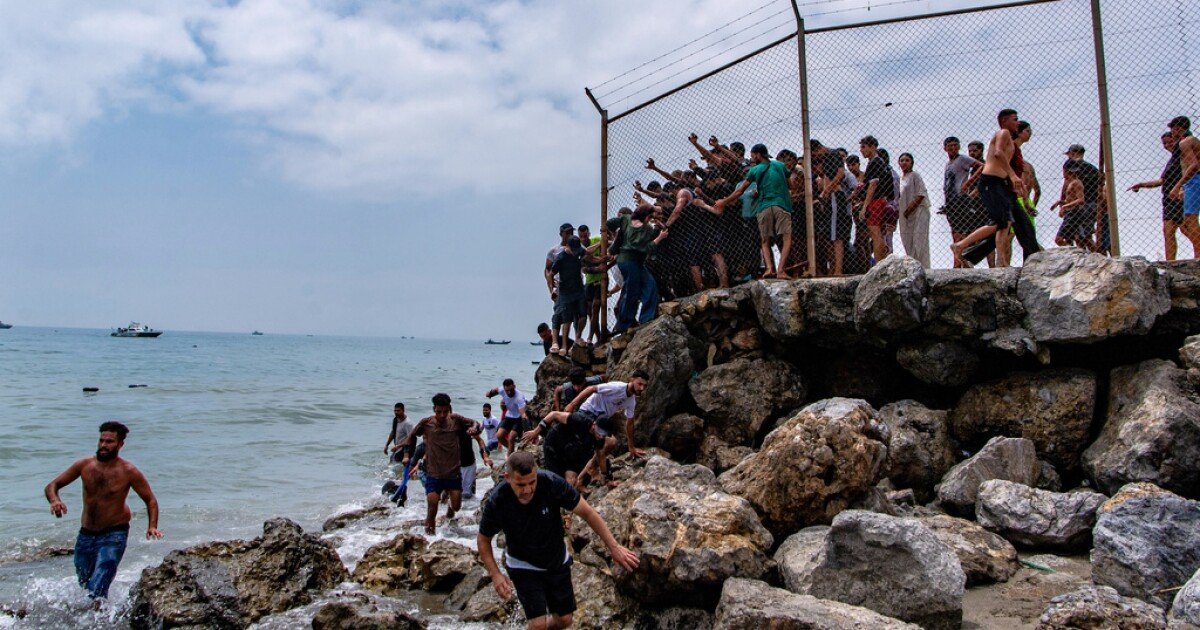
Spain has deployed military personnel to its North African enclave of Ceuta after thousands of migrants crossed into the territory from neighbouring Morocco, overwhelming local authorities and reigniting concerns over border security and irregular migration into Europe.
The Spanish Interior Ministry said the troops were deployed to reinforce the Civil Guard, assist in maintaining public order and support ongoing efforts to restore security in the enclave following the unprecedented influx.
The latest migration surge comes days after Spain’s Supreme Court ruled that migrants intercepted at sea while attempting to reach Ceuta or Melilla cannot be immediately returned to Morocco. Spanish authorities alleged that human trafficking networks had exploited the ruling by encouraging undocumented migrants to attempt the dangerous crossing.
According to reports, at least 15 people lost their lives while trying to reach Ceuta by sea. Thousands of migrants reportedly swam around the border jetty after sliding down embankments into the water, leaving the coastline strewn with flotation devices and personal belongings.
Spanish Prime Minister Pedro Sánchez is expected to visit Ceuta as the government intensifies efforts to restore order and respond to the humanitarian situation. He has pledged to normalise the situation as quickly as possible.
Local officials said reception centres in the enclave had exceeded capacity, criticising the central government for what they described as a delayed response to the growing number of arrivals.
Ceuta’s regional president, Juan Jesús Vivas, described the situation as overwhelming and appealed to Madrid for urgent assistance to manage the crisis.
The development has also triggered political debate across Europe. Italian Prime Minister Giorgia Meloni said her government was considering extraordinary measures, including reviewing Spain’s participation in the Schengen open-border system, arguing that uncontrolled migration posed a broader security challenge for the European Union.
Spain, however, rejected the remarks, with Foreign Minister José Luis Albares accusing Italian officials of politicising migration and calling instead for greater European solidarity in addressing the issue.
Spanish media estimated that between 2,000 and 3,000 migrants entered Ceuta during Thursday’s mass crossing, although authorities have yet to officially confirm the figures. Reports also indicated that Moroccan security forces deployed water cannons near the border town of Fnideq in an effort to prevent additional crossings.
The latest incident has drawn comparisons with the 2021 Ceuta migration crisis, when approximately 8,000 migrants entered the Spanish enclave within a matter of days, straining diplomatic relations between Spain and Morocco.
Ceuta and Melilla, Spain’s two autonomous enclaves in North Africa, remain the European Union’s only land borders with Africa and continue to serve as major entry points for migrants seeking access to Europe despite heightened border security measures.