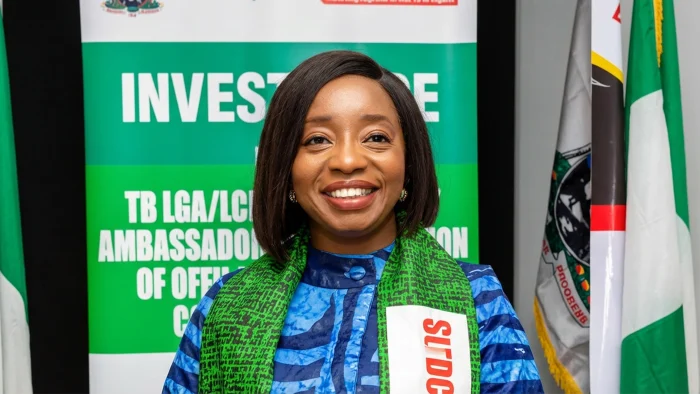
The wife of the Lagos State Governor, Dr. Ibijoke Sanwo-Olu, has called on residents to make environmental cleanliness a daily habit, emphasizing that sustained personal responsibility is essential to building a cleaner and healthier Lagos.
Speaking during the July edition of the state’s monthly environmental sanitation exercise in Eputu London, Ibeju-Lekki Local Government Area, on Saturday, Sanwo-Olu praised residents for their growing commitment to keeping their surroundings clean.
She noted that members of the community began cleaning their environment three days before the official sanitation exercise, describing the initiative as a positive sign that public awareness campaigns are making an impact.
“We are very proud of our people. When we arrived in Eputu London, we discovered that residents had already started cleaning their environment three days before the exercise. They did not wait until the last Saturday of the month. That shows that people are becoming more conscious of their environment and are taking ownership of it,” she said.
Despite the rainy season and flooding experienced in some parts of the state, Sanwo-Olu commended the impressive turnout of residents, including schoolchildren, who participated in the exercise from as early as 6:30 a.m.
She stressed the importance of instilling environmental values in younger generations, revealing that students of tertiary institutions would be included in future sanitation exercises.
“We are catching them young. These children have been here very early this morning because whatever values we pass on to them today, they will continue in the future. By the grace of God, from next month, students of tertiary institutions will also participate. This is a collective responsibility,” she said.
The First Lady encouraged Lagos residents to continue participating in the monthly sanitation programme, held on the last Saturday of every month between 6:30 a.m. and 8:30 a.m., while maintaining proper sanitation practices every day.
Also speaking, the Commissioner for the Environment and Water Resources, Tokunbo Wahab, said the Lagos State Government is expanding waste management infrastructure to improve refuse collection and disposal across the state.
He disclosed that work is ongoing at the Olusosun waste management facility, where a waste transfer loading station and a material recovery facility are being developed to boost waste processing capacity.
According to Wahab, the Lagos Waste Management Authority (LAWMA), in collaboration with Private Sector Participants (PSP) operators, is strengthening waste collection services while intensifying public awareness campaigns.
“The ultimate goal is to ensure efficient waste management across the state. LAWMA and PSP operators are putting in significant effort, but residents must also take ownership of the process. People should not dump refuse on road medians, drainage channels or public spaces because those facilities belong to all of us,” he said.
The commissioner acknowledged that changing entrenched habits would require time but expressed confidence that sustained advocacy, consistent enforcement, and public cooperation would gradually improve environmental compliance.
He urged residents experiencing delays in waste collection to report such issues to LAWMA rather than resorting to indiscriminate dumping of refuse, particularly in drainage channels.
“If residents are paying for waste collection services, service providers must deliver. Where there are lapses, people should contact LAWMA so that appropriate action can be taken,” Wahab added.
He reiterated that while public enlightenment remains the government’s preferred strategy, sanctions would continue to be imposed on environmental offenders where necessary.
Meanwhile, in a parallel sanitation exercise in Badagry Local Government Area, the Special Adviser to the Governor on Environment and Water Resources, Engr. Olakunle Rotimi-Akodu, reaffirmed the state’s commitment to tackling indiscriminate waste disposal and other environmental violations.
Rotimi-Akodu commended Community Development Associations (CDAs) and Community Development Committees (CDCs) for their active participation, noting that the inclusion of students in the monthly sanitation programme is intended to nurture a new generation of environmental advocates.
“The involvement of students is deliberate. We want to catch them young and groom them as environmental champions who will protect the future of Lagos,” he said.