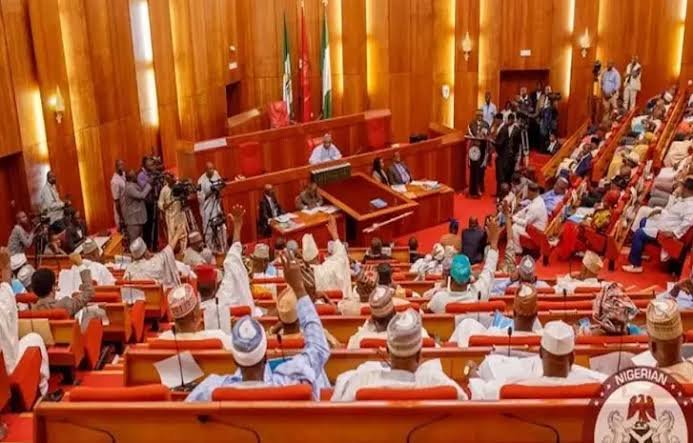
The Senate has initiated moves to compel the Central Bank of Nigeria (CBN), the Nigerian National Petroleum Company Limited (NNPCL), and 39 other Ministries, Departments and Agencies (MDAs) to appear before its Committee on Finance as part of an ongoing investigation into alleged failures to remit statutory revenues to the Federal Government.
The decision followed the adoption of a motion during Wednesday’s plenary, after the Chairman of the Senate Committee on Finance, Senator Sani Musa, accused several revenue-generating agencies of frustrating legislative oversight by repeatedly ignoring invitations and failing to provide requested financial records.
According to Musa, the committee is conducting the investigation in line with Sections 88 and 89 of the 1999 Constitution (as amended), which empower the National Assembly to examine the financial activities of government-owned enterprises and agencies. The probe covers internally generated revenue, stamp duty collections, operating surpluses and statutory remittances to the Consolidated Revenue Fund (CRF).
The senator expressed concern that despite several invitations, many of the affected agencies either failed to honour the summons or argued that they were not obliged to appear before the committee.
He said such actions undermine the National Assembly’s constitutional oversight responsibilities and weaken transparency, accountability and fiscal discipline in the management of public resources.
Musa further alleged that several agencies had breached the Fiscal Responsibility Act and the Finance Act 2022 by withholding revenues that should have been remitted to the Federal Government.
“Most of them do not comply. Instead of remitting what is required by law, they retain the larger percentage of the revenue and remit only a fraction. We need to call them to order,” he said.
He also claimed that some agencies had retained government funds since 2020, adding that the committee would work closely with the Fiscal Responsibility Commission (FRC) to reconcile their financial records and recover all outstanding remittances.
Senate President Godswill Akpabio, who also spoke during the debate, dismissed claims by some agencies that Senate committees lack the constitutional authority to summon them.
“The Senate has the power. The National Assembly has the power. We have the powers enshrined in the Constitution to invite them,” Akpabio said.
He directed the Committee on Finance to submit a substantive motion empowering the Senate to compel the attendance of all defaulting agencies.
“Come with a substantive motion. One of the prayers should be to compel them to appear before the National Assembly through your committee,” he said, warning that the Senate would invoke constitutional measures against agencies that continue to ignore legislative summons.
The motion was subsequently adopted by a voice vote.
Among the agencies expected to appear before the committee are the CBN, NNPCL, Federal Airports Authority of Nigeria (FAAN), Nigerian Civil Aviation Authority (NCAA), Nigerian Maritime Administration and Safety Agency (NIMASA), Office of the Accountant-General of the Federation, Nigerian Railway Corporation, Small and Medium Enterprises Development Agency of Nigeria (SMEDAN), Transmission Company of Nigeria (TCN), Nigerian Electricity Regulatory Commission (NERC), Nigerian Ports Authority (NPA), Nigerian Upstream Petroleum Regulatory Commission (NUPRC), Nigerian Midstream and Downstream Petroleum Regulatory Authority (NMDPRA), National Hajj Commission of Nigeria (NAHCON), Joint Admissions and Matriculation Board (JAMB), National Examinations Council (NECO), Nigeria Deposit Insurance Corporation (NDIC), Nigeria Export Processing Zones Authority (NEPZA), National Insurance Commission (NAICOM), Nigeria Social Insurance Trust Fund (NSITF), National Oil Spill Detection and Response Agency (NOSDRA), and several other federal agencies.
The Senate said the investigation is intended to strengthen compliance with existing financial laws, improve fiscal accountability and ensure that all revenues due to the Federal Government are fully remitted into the Consolidated Revenue Fund.