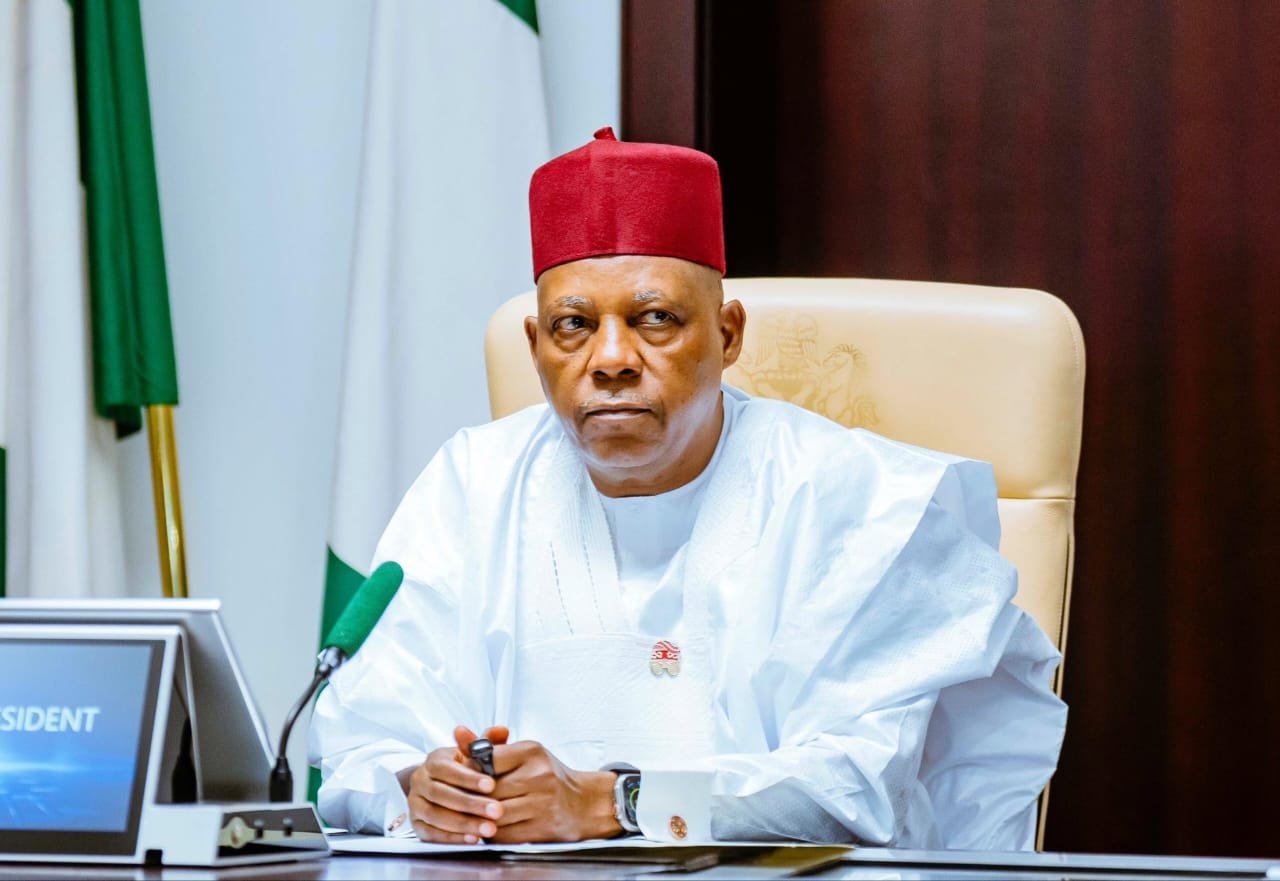
Vice President Kashim Shettima has reaffirmed the Federal Government’s commitment to improving the welfare and future of Nigerian children through a broad range of social investment, nutrition, education and human capital development program being implemented under President Bola Tinubu’s administration.
Speaking on Thursday while receiving the Executive Director of the United Nations Children’s Fund (UNICEF), Catherine Russell, and her delegation during a courtesy visit to the Presidential Villa in Abuja, Shettima said the Tinubu administration has placed the development of Nigerian children at the heart of its national renewal agenda.
The Vice President said one of the greatest tragedies any nation could face is raising a generation of children uncertain about their future, stressing that Nigeria’s youthful population makes it imperative for government to create opportunities that allow every child to realize his or her full potential.
According to him, despite inheriting significant economic and social challenges, the administration has continued to deepen collaboration with global development partners such as UNICEF to improve the lives of children across the country.
Shettima described UNICEF as a dependable partner whose expertise and support have strengthened critical sectors affecting the wellbeing of Nigerian children.
Highlighting key interventions of the administration, the Vice President said the Nutrition 774 Initiative is creating a governance framework for nutrition in all 774 local government areas of the country. He disclosed that more than ₦7.6 billion has already been mobilized through the Child Nutrition Fund matching investments, while essential micronutrients are being distributed to millions of women and children under the Presidential Nutrition Intervention Fund.
He also outlined the Nigeria 2050 Child Foresight Analysis, an initiative supported by UNICEF to promote long-term planning in public policy through evidence-based recommendations on education, climate resilience and youth livelihoods. He noted that the program is gradually being expanded to the sub-national level through a multi-stakeholder technical working group.
On youth empowerment, Shettima said the Generation Unlimited Nigeria (GenU) initiative is being strengthened to achieve its target of connecting 20 million Nigerian youths to sustainable livelihoods by 2030.
The Vice President further highlighted the National Human Capital Development Program, which seeks to position Nigeria among the world’s top 80 countries on the Human Capital Index by 2030 through investments in healthcare, nutrition, education and employment opportunities.
He said the various program reflect President Tinubu’s belief that meaningful investment in children today is essential to building a stronger and more prosperous Nigeria in the future.
Shettima also reiterated the administration’s commitment to implementing the Universal Child Benefit program, noting that President Tinubu has designated 2026 as the Year of Family and Social Protection. He explained that the Renewed Hope Baby Support Initiative would serve as the implementation framework for the program, adding that governors in the North-West have already endorsed the initiative while Lagos State is preparing to commence implementation.
Commending UNICEF’s longstanding partnership with Nigeria, the Vice President said the organization’s contributions extend beyond humanitarian assistance to strengthening national institutions and supporting sustainable development.
Earlier, UNICEF Executive Director Catherine Russell praised President Tinubu and Vice President Shettima for introducing structural reforms aimed at improving opportunities for Nigerian children.
She reaffirmed UNICEF’s commitment to supporting Nigeria’s efforts to expand access to quality healthcare, education and social protection, describing the country as a key partner in advancing child welfare on the African continent.
Also speaking, the Coordinating Minister of Health and Social Welfare, Prof. Muhammad Ali Pate, commended UNICEF’s support for Nigeria’s health sector, noting that the organization plays a central role in vaccine procurement and provides critical technical assistance to government institutions.
He said the Federal Government would continue to strengthen its collaboration with UNICEF in delivering healthcare and social protection program for the benefit of Nigerian children.