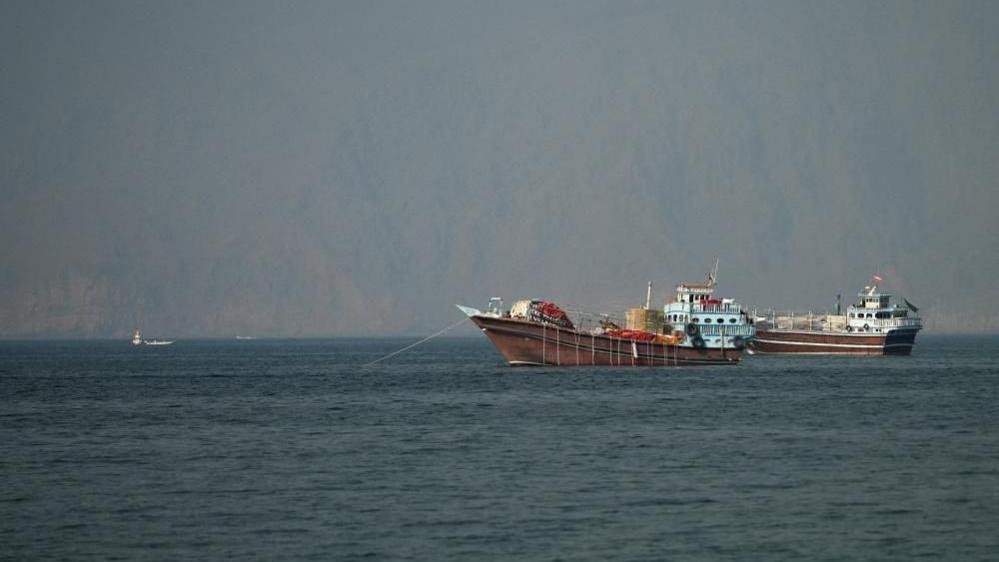
The United States has carried out military strikes on Iranian targets after President Donald Trump accused Tehran of violating a ceasefire agreement following a drone attack on a cargo ship in the Strait of Hormuz.
According to US Central Command (CENTCOM), American forces struck missile and drone storage facilities as well as coastal radar sites on Friday. The strikes came in response to Thursday’s drone attack on a commercial cargo vessel, which disrupted plans to evacuate sailors stranded in the region.
Iran said the vessel was targeted because it had used an unauthorised route while transiting through the strategic Gulf waterway.
Following the US operation, Iran accused Washington of breaching their interim agreement and announced retaliatory strikes against targets linked to American forces.
US Condemns Attack on Commercial Shipping
CENTCOM described the military action as “a powerful response” to what it called an unprovoked attack on commercial shipping.
“The unwarranted aggression against commercial shipping by Iranian forces clearly violated the ceasefire,” the command said in a statement. It added that Iran’s actions threatened freedom of navigation through one of the world’s most important maritime trade routes.
The US military said it would continue coordinating and supporting the safe passage of commercial vessels through the Strait of Hormuz.
Iran Announces Retaliation
Iran’s Foreign Ministry said on Saturday that its military had struck targets associated with US forces in response to the American attacks, blaming what it described as the “treaty-breaking US regime” for escalating tensions.
The Islamic Revolutionary Guard Corps (IRGC) also claimed its navy had targeted US military positions in the region but did not provide further details.
The Pentagon has not publicly commented on Iran’s claims.
Regional Tensions Rise
Bahrain’s Foreign Ministry said several Iranian drones entered its airspace early Saturday, describing the incident as a “flagrant violation” of the country’s sovereignty and accusing Tehran of undermining regional peace efforts.
Separately, the United Kingdom Maritime Trade Operations (UKMTO) reported that a tanker was struck by an unidentified projectile in the Strait of Hormuz. While the vessel’s bridge sustained damage, all crew members were reported safe, and no environmental pollution was recorded.
Strait of Hormuz Remains a Global Flashpoint
Iran effectively closed the Strait of Hormuz after US and Israeli military operations against the country began in late February. The disruption to one of the world’s busiest energy shipping lanes triggered a sharp rise in global oil prices and affected shipments of key commodities, including fertiliser.
On 17 June, Washington and Tehran agreed to a 14-point memorandum of understanding aimed at ending hostilities. The agreement included a commitment by Iran to make its “best efforts” to ensure the safe passage of commercial vessels through the strait without imposing charges for 60 days.
Following Friday’s US strikes, Vice-President JD Vance said on X that any disagreements over the agreement should be resolved through dialogue.
“If Iran has disagreements about how the MOU is being applied, they can pick up the phone,” he wrote. “But violence will be met with violence.”
Iranian lawmaker Ebrahim Azizi, who heads parliament’s national security commission, rejected the US position, accusing Washington of attacking Iran while negotiations were still ongoing.
“This reckless violation of the ceasefire will, as always, lead to retreat and regret on their part,” he wrote on social media.
Trump Warns Iran
Speaking at the White House on Friday, President Trump declined to specify how the US would respond to the cargo ship attack or whether he still considered the ceasefire intact.
“You’ll find out,” Trump told reporters. “I don’t like the fact that they took a shot yesterday. They shouldn’t be doing that.”
Asked why he believed Iran launched the operation, Trump responded only that “they’re a little bit different.”
Earlier this week, Trump said negotiations with Tehran were progressing and claimed Iran had assured Washington that it would not impose tolls or additional charges on vessels passing through the Strait of Hormuz.
“If this is false information, negotiations would end, immediately,” he wrote on Truth Social.
The US has consistently opposed any attempt by Iran to charge vessels transiting the strait, arguing such a move would violate international maritime law.
Talks Continue Despite Dispute
Iranian and Omani officials met in Muscat earlier this week to discuss the future management of navigation through the Strait of Hormuz. Omani Foreign Minister Badr Al-Busaidi said both countries remained committed to ensuring toll-free and safe passage.
However, Iran’s chief negotiator, Mohammed Bagher Ghalibaf, indicated that future management of the strategic waterway would differ from pre-war arrangements, saying the administration of the strait “will never go back to the way it was before the war.”
Cargo Ship and Sailor Evacuation
The cargo ship targeted on Thursday was identified as the Singapore-flagged Ever Lovely. UKMTO said the vessel was struck approximately 7.5 nautical miles southeast of Oman’s Port of Dahit.
The ship’s owner, Evergreen, said the vessel had been following UKMTO’s recommended transit route at the time of the attack.
“All crew members remain safe, as does the vessel itself and all cargo,” the company said.
Following the incident, the International Maritime Organization (IMO) suspended plans to evacuate more than 11,000 sailors who have remained stranded in the region since the conflict began.