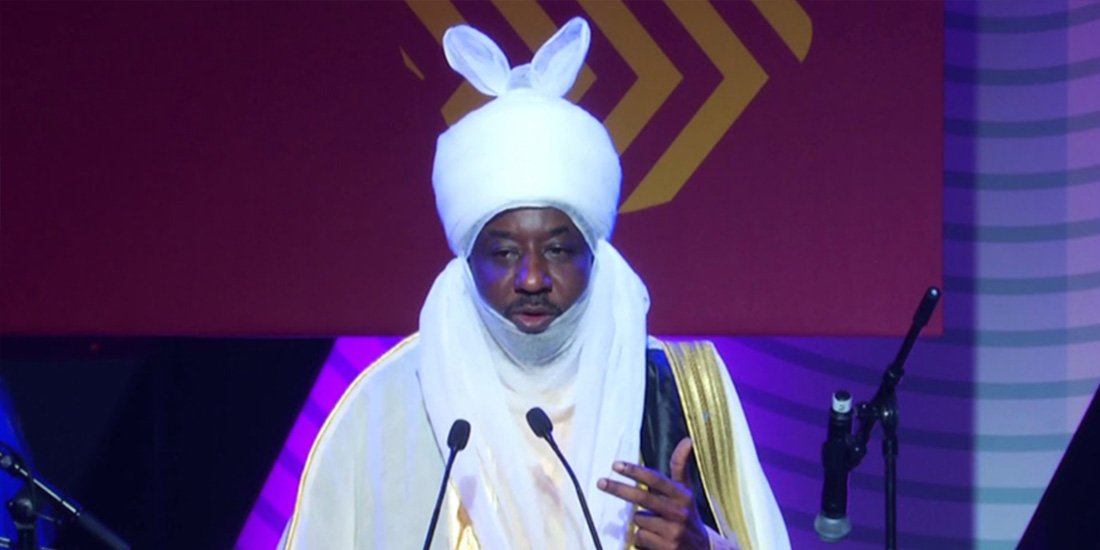
The Emir of Kano and former Governor of the Central Bank of Nigeria (CBN), Muhammadu Sanusi II, has cautioned the Economic Community of West African States (ECOWAS) against rushing the introduction of the proposed ECO common currency, warning that launching a monetary union without strong economic fundamentals could undermine its success.
Sanusi gave the warning on Thursday while delivering a keynote address at a one-day policy dialogue titled “ECO Currency and Monetary Integration in West Africa: Implications for Nigeria,” organised by the National Institute for Legislative and Democratic Studies (NILDS) in Abuja.
The former CBN governor said West African economies were yet to satisfy the essential conditions required for a sustainable common currency, stressing that monetary integration should be driven by economic readiness rather than political ambition.
“A currency is only as strong as the economy behind it,” Sanusi said. “History shows us that successful monetary unions are built on economic convergence, institutional credibility and shared prosperity, not aspiration alone.”
He acknowledged that the proposed ECO currency could deliver significant benefits, including lower transaction costs, increased intra-regional trade and greater competitiveness. However, he argued that those gains would only be realised if member states first strengthened their economies and institutions.
According to Sanusi, West Africa’s population of approximately 450 million people and a combined Gross Domestic Product (GDP) estimated at nearly $900 billion present enormous opportunities for economic growth.
“The challenge before us is transforming this population into purchasing power, productivity and market integration,” he said.
The Emir described the region’s youthful population as a strategic economic asset, urging governments to invest in education, skills development and job creation to harness its potential.
“These youths should become productive economic agents rather than being left vulnerable to crime, terrorism and social unrest,” he said.
Sanusi also argued that a common currency could make West Africa more attractive to international investors by creating a larger integrated market free from exchange-rate barriers.
“Investors are better off looking at a West African economy with a single currency and no trade barriers than looking at Nigeria, Ghana or Sierra Leone individually,” he noted.
Despite the potential advantages, Sanusi insisted that the ECO currency should be the culmination of a broader integration process rather than its starting point.
“The common currency is often the most visible feature of a monetary union, but success depends on deeper economic and institutional foundations,” he said, describing the ECO as “the last step at the top of a pyramid.”
He identified macroeconomic convergence, fiscal discipline, institutional credibility, financial integration, labour mobility and trade integration as essential prerequisites for a successful regional currency.
Sanusi also expressed concern that ongoing political tensions between ECOWAS and the Alliance of Sahel States (AES)—comprising Niger, Burkina Faso and Mali—could jeopardise efforts to establish the ECO.
“You cannot be talking about a common currency with Niger, Burkina Faso and Mali while threatening them with force over their internal affairs. They will not even listen to you,” he said.
He urged regional leaders to prioritise reconciliation and dialogue, stressing that the unity of West Africa remained essential for meaningful economic integration.
“The unity of West Africa is sacrosanct. Whatever issues exist should be resolved within the framework of a united ECOWAS,” he added.
Drawing lessons from the European Union, Sanusi observed that Europe achieved significant economic convergence and institutional harmonisation before adopting the euro, noting that West Africa should follow a similar path.
The former CBN governor also defended the independence of central banks, warning against political interference in monetary policy and excessive money creation.
“The central bank is not there as a printing press. You cannot print money and expect a strong exchange rate or stable prices,” he said.
Reflecting on his tenure as CBN governor, Sanusi said former Presidents Umaru Musa Yar’Adua and Goodluck Jonathan respected the autonomy of the apex bank by refraining from influencing monetary policy decisions.
He also raised concerns over Nigeria’s growing debt profile, warning that excessive borrowing without clear returns could threaten long-term fiscal sustainability.
“We are borrowing today like there is no tomorrow. We need to know where the money is going. We need fiscal sustainability,” he said.
Presenting data on inflation, fiscal deficits and trade within the ECOWAS region, Sanusi argued that member states remain far from achieving the convergence needed for a viable monetary union.
He noted that intra-regional trade currently accounts for only about 10 to 12 per cent of total trade within West Africa, compared to approximately 60 per cent among European Union member states.
“For you to get to ECO, you need trade of around 60 per cent where the benefits clearly outweigh the costs of giving up monetary independence,” he said.
Sanusi concluded that the primary objective of the ECO project should be to build a prosperous, competitive and integrated West African economy rather than simply introducing a common currency.
“Build the foundations first—macroeconomic convergence, payment system integration, trade integration, infrastructure and connectivity. The common currency comes last,” he said.
Earlier, the Director-General of NILDS, Abubakar O. Sulaiman, described the proposed ECO currency as one of the most significant economic and political initiatives ever contemplated within the ECOWAS region.
He said the dialogue was organised to examine the practical implications of monetary integration, particularly for Nigeria, and to generate policy recommendations that would guide lawmakers and policymakers in protecting the country’s economic interests while advancing regional integration.