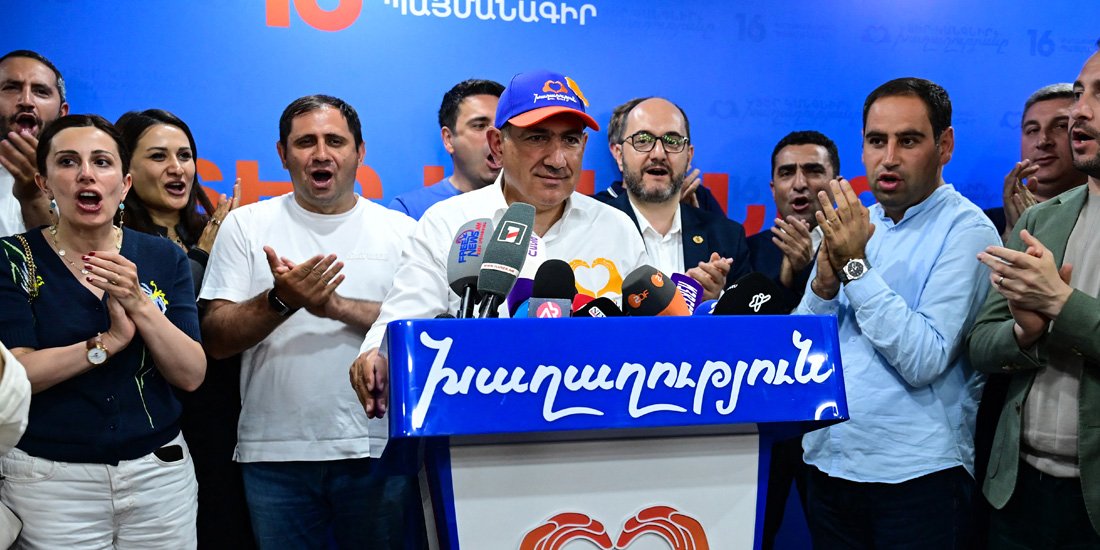
Armenian Prime Minister Nikol Pashinyan and his ruling Civil Contract party have secured victory in the country’s parliamentary elections, according to preliminary results released on Monday, reinforcing Armenia’s recent shift toward closer ties with Western nations.
Results announced by the Central Election Commission showed Civil Contract won 49.8 percent of the vote after ballots from all electoral precincts were counted.
The party finished well ahead of the Strong Armenia alliance, led by Russian-Armenian businessman Samvel Karapetyan, which secured 23.3 percent of the vote.
Two additional opposition groups also crossed the electoral threshold to gain representation in parliament. The Armenia Alliance, led by former President Robert Kocharyan, won 9.9 percent of the vote, while the Prosperous Armenia Party received four percent.
Voter turnout stood at 59 percent, according to electoral authorities.
Reacting to the outcome, Pashinyan described the result as a “historic victory” and pledged to continue pursuing reforms aimed at strengthening the country’s development and sovereignty.
He also reaffirmed his government’s policy of deepening cooperation with Western partners while maintaining relations with Russia.
“Our course of rapprochement with the West will continue, while we also seek to develop our relations with Russia,” Pashinyan said.
However, opposition leader Karapetyan rejected the outcome, describing the election as “shameful” and alleging widespread violations and political repression. He claimed that dozens of his campaign workers had been detained during the election period.
The Armenian Investigative Committee said it had opened 59 criminal investigations into alleged electoral violations, including cases of multiple voting, and confirmed that nine individuals had been detained.
The election comes amid growing geopolitical tensions as Armenia seeks to reduce its dependence on Moscow. Pashinyan’s administration has suspended participation in a Russia-led security alliance, strengthened ties with the European Union and the United States, and initiated steps toward possible EU membership.
Russia has expressed concern over Armenia’s foreign policy direction. Earlier this year, Russian President Vladimir Putin warned against closer integration with the European Union, drawing comparisons with developments in Ukraine.
In the lead-up to the election, Armenian officials raised concerns about alleged foreign interference, citing online disinformation campaigns, cyber activities, and narratives perceived as supportive of Kremlin interests.
Analysts also noted that Russia imposed restrictions on imports of several Armenian products in the weeks before the vote, a move widely interpreted as increasing economic pressure on Yerevan.
Despite the tensions, many Armenian voters continue to view opposition parties as closely linked to Russian influence and the country’s traditional oligarchic political structures, factors that may have contributed to the ruling party’s strong performance at the polls.