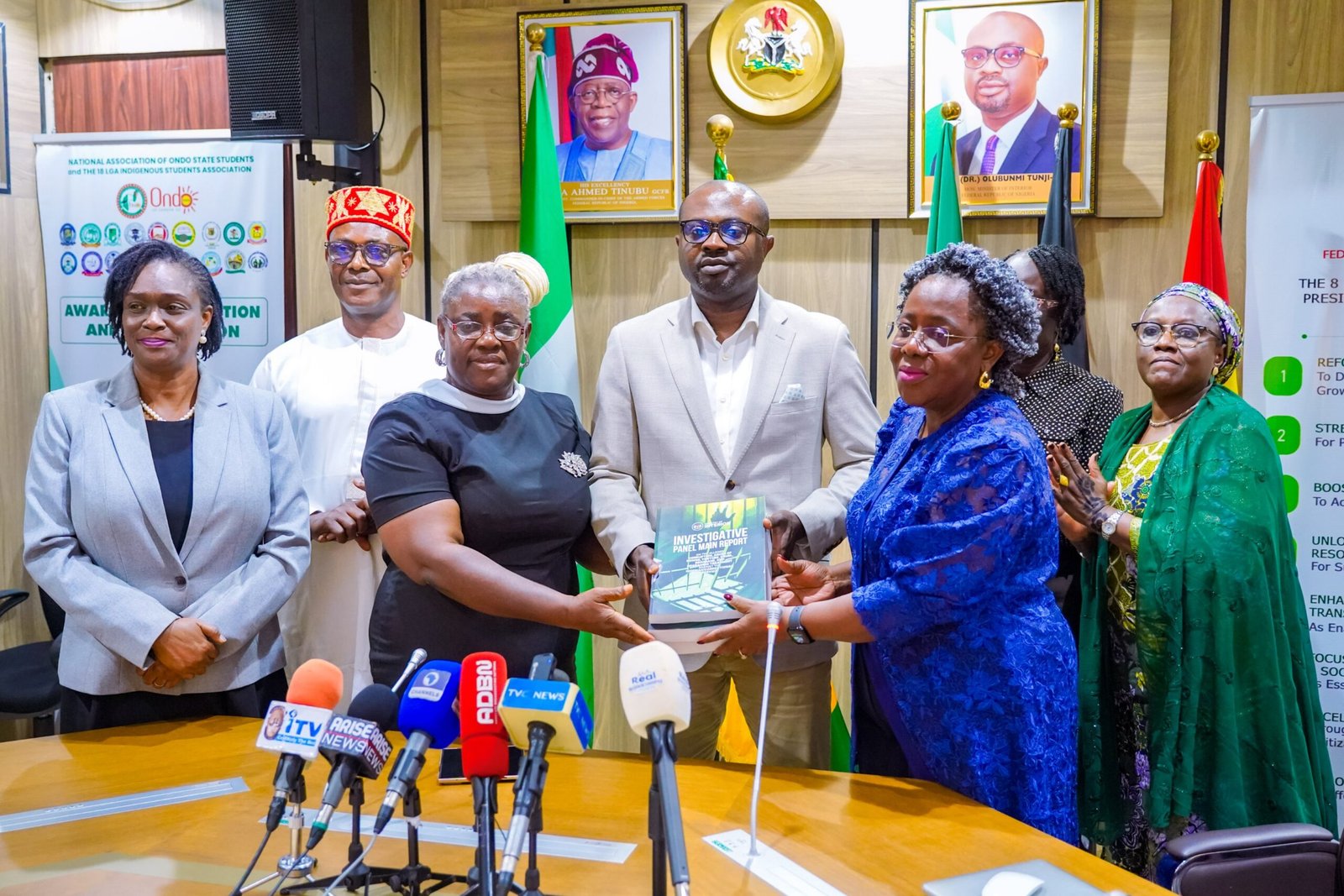
The Federal Government has received the final report of the Independent Investigative Panel established to examine allegations of corruption, abuse of power, torture, and other forms of inhumane and degrading treatment within the Nigerian Correctional Service.
Minister of Interior, Olubunmi Tunji-Ojo, announced the development on Wednesday, describing the submission of the report as a major milestone in the government’s efforts to reform the country’s correctional system.
The panel, chaired by the Ministry’s Permanent Secretary, Magdalene Ajani, was inaugurated in November 2024 and completed its assignment after 18 months of investigations.
According to the minister, the findings and recommendations of the committee will provide a framework for transforming correctional centres into institutions focused on rehabilitation, reformation, restoration, and reintegration rather than mere incarceration.
Tunji-Ojo noted that ongoing reforms within the correctional system have already yielded significant results, particularly in reducing recidivism rates.
He disclosed that the number of repeat offenders in custody declined sharply from 11,616 inmates in 2023 to 1,382 in 2025, attributing the improvement to targeted rehabilitation programmes.
The minister also highlighted educational and vocational initiatives currently being implemented across correctional facilities nationwide. According to him, 62 inmates are pursuing postgraduate studies, 261 are enrolled in undergraduate programmes, 1,125 are engaged in ongoing educational pursuits, while 9,582 inmates are participating in non-formal vocational and skills acquisition training.
He stressed that the core objective of the correctional system should be to reform offenders, protect society, and provide opportunities for inmates to rebuild their lives.
“The essence of a correctional service must be transformational and corrective, ensuring compliance with the law while protecting society and restoring hope,” the minister said.
Tunji-Ojo assured that the Federal Government would move swiftly from the report stage to implementation, backed by monitoring and evaluation mechanisms designed to ensure lasting reforms.
He reiterated the administration’s commitment to eliminating corruption, discrimination, and dehumanising practices within correctional facilities, while creating an environment that prepares inmates for productive reintegration into society.
The minister said the government’s long-term vision is to ensure that correctional centres become institutions where lives are rebuilt and former inmates are equipped to contribute meaningfully to national development.