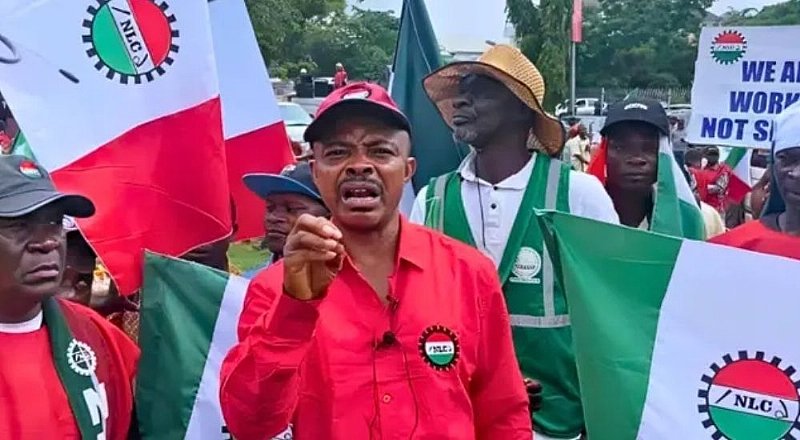
The Nigeria Labour Congress (NLC) has rejected the proposal of a N100,000 national minimum wage reportedly being considered by state governors, insisting that Nigerian workers require a living wage of up to N1 million to cope with prevailing economic realities.
Speaking in an interview on Sunday, NLC spokesperson Benson Upah described the proposed figure as grossly inadequate given the current economic situation in the country.
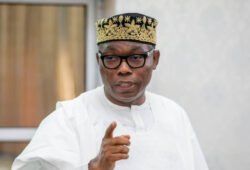
His comments came in response to remarks by the Chairman of the Nigeria Governors’ Forum (NGF) and Governor of Kwara State, AbdulRahman AbdulRazaq, who revealed that governors were considering a new minimum wage of N100,000.
AbdulRazaq made the disclosure during a Sallah homage to President Bola Tinubu in Lagos, noting that governors were already engaging the Federal Government and organised labour to develop a wage structure that balances workers’ welfare with fiscal sustainability.
In a Facebook post on Saturday, the governor explained that the proposal was driven by rising inflation, increasing living costs and the growing financial pressure on Nigerian workers.
Reacting to the development, Upah acknowledged the governors’ willingness to review workers’ wages but maintained that the proposed amount falls far short of what is needed.
“We consider it thoughtful of the Kwara State Governor for proposing this, but certainly, N100,000 falls far below the realistic figure,” he said.
The labour leader pointed to the depreciation of the naira, persistent inflation, higher electricity tariffs, increased fuel prices, declining purchasing power and the impact of recent tax measures as reasons for demanding a substantially higher wage.
“Given the realities around the exchange rate, inflation, raised tariffs, surge in the pump price of petrol and associated costs, decline in the purchasing power of the average worker, and the effects of the new tax regime on our cost of living, the realistic figure, subject to the maintenance of the status quo, would be N1 million,” Upah stated.
He further argued that improved government revenues should make better worker remuneration achievable.
“In light of the earnings by governments, this should not be a big issue. Check what is being shared at FAAC. The windfall from the Middle East war has put over N5 trillion in the treasury. Though this is temporary, it is nonetheless very good for governments,” he said.
Upah also stressed that the workforce remains the most valuable asset of any nation and should be adequately compensated to drive productivity and economic growth.
“The greatest asset of any nation is its workforce,” he added.
The debate over workers’ wages has intensified amid worsening economic conditions following the removal of fuel subsidies and the floating of the naira by the Federal Government.
In July 2024, the Federal Government approved a new national minimum wage of N70,000 after prolonged negotiations with organised labour. The agreement replaced the previous N30,000 minimum wage enacted in 2019.
Although organised labour had initially demanded a much higher wage, negotiations eventually produced the N70,000 benchmark. However, labour leaders have continued to argue that the current wage is insufficient in the face of rising inflation and increasing living costs.
Recent data from the National Bureau of Statistics indicates that food and headline inflation remain elevated, leaving many workers struggling to meet basic household expenses despite the wage increase.
Meanwhile, the Nigeria Governors’ Forum has yet to formally submit any proposal on a new minimum wage framework to either the Federal Government or organised labour.