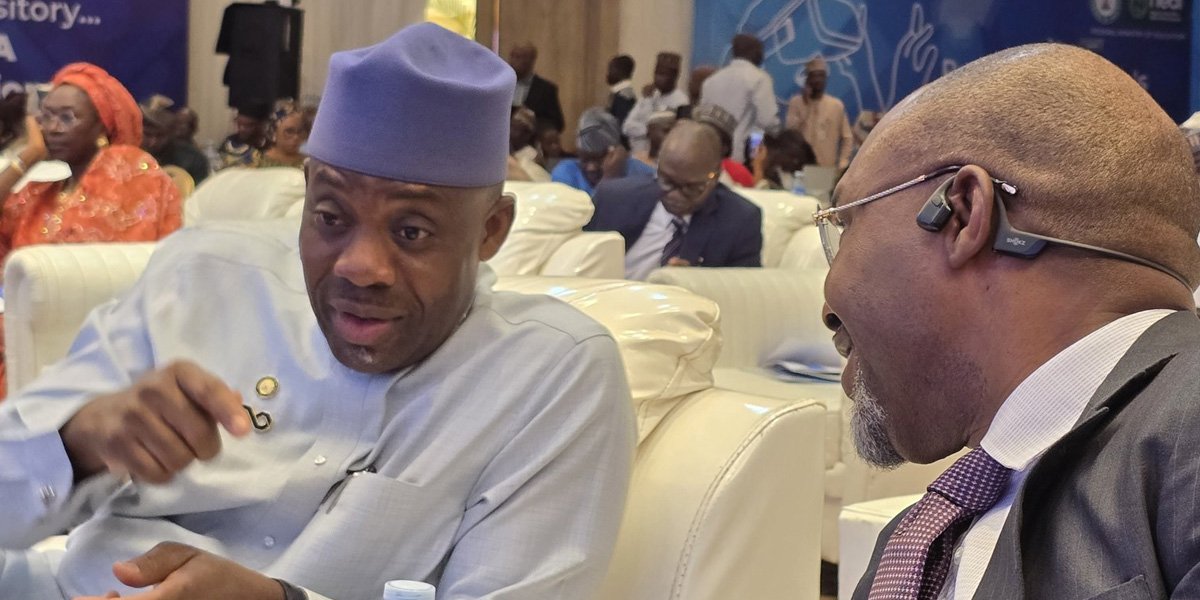
Former Minister of Aviation Osita Chidoka has called for greater national attention to education reform, warning that delays in fixing the sector could permanently affect millions of Nigerian children.
Chidoka stated this while reflecting on the recent National Stakeholders Meeting on the National Education Data Infrastructure led by the Minister of Education, Tunji Alausa.
According to him, investments in education should take priority over physical infrastructure projects because missed educational opportunities often cannot be recovered.
“Roads can wait. Buildings can wait. Airports can wait. Education cannot,” Chidoka said.
He noted that while delayed infrastructure projects could still be completed in the future, children forced out of school due to policy failures may never regain access to education.
Nigeria is estimated to have about 15 million out-of-school children, a situation Chidoka described as a national emergency requiring urgent and evidence-based intervention.
He described the newly unveiled Nigeria Education Management Information System as a major step toward improving education planning and policy implementation across the country.
The platform, developed by Ernst & Young, provides nationwide education data, including school enrolment figures, student-teacher ratios and the condition of educational infrastructure across states.
Chidoka said the system would allow policymakers to compare data easily and make informed decisions capable of addressing longstanding challenges in the education sector.
During the stakeholders’ meeting, he said two key statistics stood out to him.
The first was the significant gap between primary school enrolment and junior secondary school enrolment, which he said raised troubling questions about what happens to many Nigerian children after completing primary education.
“The drop is so wide that I found myself asking the obvious question: what happened to those children?” he stated.
He also pointed to the high number of repeat candidates sitting for examinations conducted by the Joint Admissions and Matriculation Board (JAMB), describing it as evidence of severe admission bottlenecks in Nigeria’s tertiary education system.
According to him, the data helped him better understand ongoing policy efforts by the education ministry aimed at expanding access to higher education.
“That is the power of credible, real-time data. It does not merely inform policy; it humbles assumptions,” he said.
Chidoka also disclosed that the Nigeria Research and Education Network (NgREN) would begin delivering connectivity and digital services to tertiary institutions this year, with plans to extend similar infrastructure to secondary schools by 2027.
He added that important reforms were quietly taking shape within the education sector, noting that evidence-based governance was gradually replacing assumptions in policy formulation.
Chidoka further challenged other sectors of government to adopt similar data-driven approaches to governance and public policy decisions.