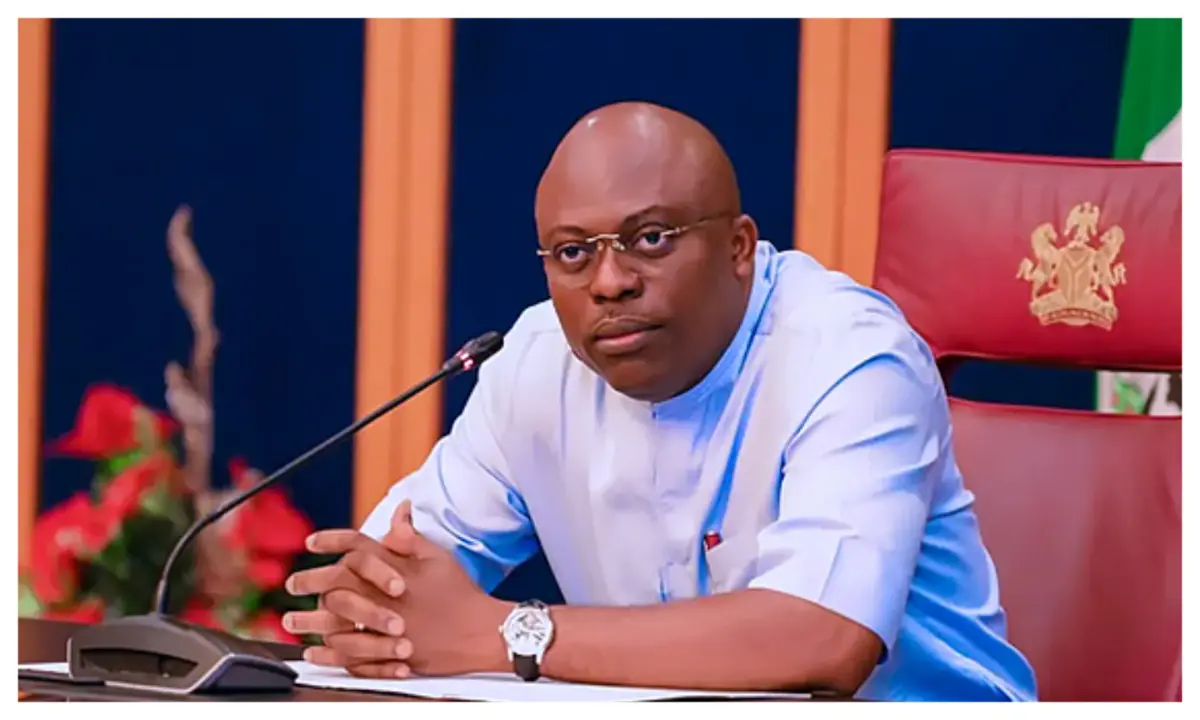
The All Progressives Congress governorship screening exercise unfolding in Abuja has laid bare the depth of the political crisis tearing through Rivers State, culminating in a remarkable scene on Sunday when Governor Siminalayi Fubara abruptly departed the screening venue amid what credible party sources described as a deliberate and calculated cold reception orchestrated against him. What was meant to be a routine procedural exercise ahead of the 2027 general elections instead became a theatre of political warfare, with every movement, gesture, and silence at the Plateau State Governor’s Lodge in Asokoro carrying enormous symbolic weight.
Governor Fubara arrived at the designated screening venue at approximately 3:15 p.m. on Sunday, May 10, conspicuously a day after most of his fellow incumbent governors had completed the same exercise. His absence on Saturday had already fuelled speculation about the troubled state of his relationship with the party’s influential power brokers, a sentiment reinforced by the fact that governors including Abba Kabir Yusuf of Kano, Inuwa Yahaya of Gombe, Nasir Idris of Kebbi, Caleb Mutfwang of Plateau, Hyacinth Alia of Benue, Francis Nwifuru of Ebonyi and the Governor of Delta State had all sailed through the Yilwatda-led committee without drama or incident.
What followed inside the screening room did nothing to quell those concerns. Within twenty minutes, the governor was back on his feet and heading for the exit, his demeanour visibly altered. Journalists who had maintained a long vigil outside the venue surged toward him, hoping for a statement that would shed light on the proceedings. The governor offered none. His only words were a terse “No comment” before he walked away.
The body language spoke volumes where words would not. Observers present at the venue noted that the committee had consistently escorted outgoing governors with visible warmth and ceremony throughout the exercise, a protocol interpreted widely as an institutional endorsement of the screening process. When Fubara emerged, no committee member accompanied him. The panel reportedly remained in the screening room for a further six minutes after his departure, a detail that did not go unnoticed among political watchers at the scene.
The drama surrounding Fubara cannot be fully appreciated without examining what was simultaneously unfolding at a separate screening sitting chaired by APC Deputy National Chairman Benjamin Nwoye. While Fubara was appearing before the committee led by APC National Chairman Professor Nentawe Goshwe Yilwatda, the Nwoye panel was busy receiving aspirants with unmistakable ties to FCT Minister Nyesom Wike. House of Representatives Minority Leader Kingsley Chinda, who recently concluded a high-profile defection from the Peoples Democratic Party to the APC, was screened by that committee. So too was Alabo Dakorinama George Kelly, a former Rivers State Commissioner for Works and a figure long associated with Wike’s political machinery. Also screened by the same panel was Sir Tonye Cole, the APC’s governorship candidate in the 2023 election. The contrast in atmospheres between the two sittings, and the trajectory of their outcomes, has not been lost on observers. While Fubara’s screening was followed by institutional ambiguity and official silence, sources indicate that the Wike-aligned aspirants were processed without incident.
The emergence of Chinda and George Kelly as governorship aspirants is not accidental. It is the product of a deliberate political strategy by Minister Wike to consolidate influence over the future of Rivers State governance through the APC platform. Reports emerging from a closed-door meeting held in Port Harcourt in early May indicate that Wike threw his weight behind George Kelly as his preferred candidate for the 2027 governorship race. The meeting, which drew notable attendance including former militant leaders Asari Dokubo and Ateke Tom, underscored the breadth of the coalition being assembled against Fubara. Chinda’s candidacy adds a parallel dimension to that strategy. As the current Minority Leader of the House of Representatives representing Obio/Akpor Federal Constituency, his entry into the governorship race further narrows the political space available to the incumbent governor. Reports also suggest that one of Wike’s close associates is being prepared to contest for Chinda’s legislative seat should the latter secure the governorship ticket, pointing to the comprehensive nature of the succession planning underway.
Not all is straightforward on the Wike side, however. Eligibility questions have emerged regarding George Kelly, who is said to have been serving in a federal political appointment at the time of the exercise. A directive issued by the Presidency through the office of the Secretary to the Government of the Federation had previously required all political appointees seeking elective positions in 2027 to tender their resignations on or before March 30, 2026. Whether George Kelly met that condition remains a point of active discussion.
The national leadership of the APC has been measured in its public response, conspicuously declining to confirm or clarify what exactly transpired during Fubara’s session with the screening panel. APC National Secretary Senator Ajibola Basiru, when pressed by journalists on whether the governor had been screened, offered a response that was notable for what it avoided saying. He stated that any individual who appeared before the committee did so as part of the required process, and that no report had yet been issued. “Once the committee has seen everyone, they will sit down and produce a report. As of now, there is no report from the screening committee,” Basiru said, before declining to elaborate further. The carefully constructed ambiguity of that statement has deepened the uncertainty surrounding Fubara’s re-election prospects, with political analysts divided on whether the governor’s brief session constituted a valid screening or something considerably less.
The broader context in which Sunday’s events unfolded is one of a state that has endured sustained political turbulence for well over two years. The friction between Fubara and Wike, his predecessor and political godfather turned adversary, has convulsed governance in Rivers State, destabilised the state legislature, and drawn in federal actors at multiple levels. What played out at the Plateau State Governor’s Lodge on Sunday was, in the assessment of many political insiders, simply the latest theatre in that ongoing conflict. The screening exercise that ought to have been an unremarkable procedural step has instead become another front in a war of attrition, one in which every procedural nuance carries political consequence.
The APC’s screening committee is expected to produce its formal report in the coming days. When it does, the contours of the Rivers governorship race will become considerably clearer. For now, one thing is beyond dispute: the battle for Rivers State in 2027 has well and truly begun, and its opening moves have been anything but subtle.