Former Minister of Foreign Affairs, Ike Nwachukwu, has issued a forceful call for the federal government to establish a dedicated foreign service commission as an urgent step toward rebuilding professionalism, institutional memory, and career dignity within Nigeria’s diplomatic corps, warning that the growing marginalization of career diplomats in favor of political appointees had significantly weakened the country’s capacity for effective international engagement.
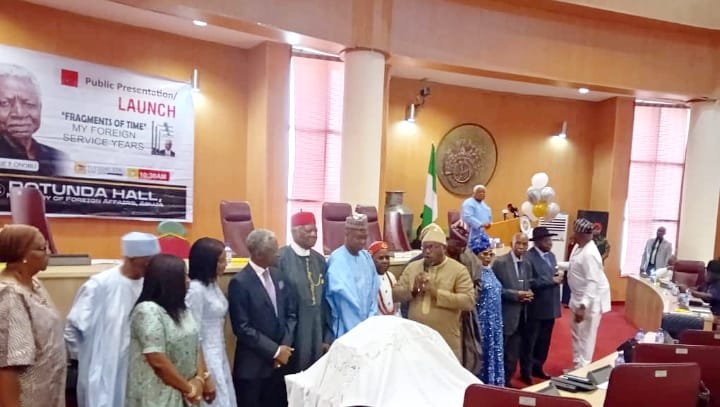
Nwachukwu made the call at the public presentation of a book titled “Fragments of Time: My Foreign Service Years,” authored by veteran diplomat Eineje Onobu, at a well-attended event in Abuja that brought together serving and retired diplomats, academics, and government officials.
He said the absence of a commission specifically responsible for the recruitment, training, and career progression of foreign service officers had left the system fragmented and demoralized, discouraging dedicated professionals who invested their careers in the service and then found themselves bypassed at the point of ambassadorial appointments.
Nwachukwu disclosed that during his tenure as minister, the government maintained a ratio of 70 percent career ambassadors to 30 percent political appointees, a balance he described as the minimum necessary to sustain institutional expertise and professionalism in foreign missions. He said that ratio had since been significantly eroded and called for its restoration, suggesting that even an 80 to 20 ratio in favor of career diplomats would produce meaningful improvements in operational effectiveness.
He also identified chronic underfunding as a major structural constraint, recalling that during his tenure a dual budgeting system was introduced to allow foreign missions to access operational funds in foreign currency, and warning that budgeting for the ministry of foreign affairs in naira while expecting missions to perform in hard currency environments created conditions for failure and potential compromise.
Chairman of the organizing committee, Godknows Igali, described diplomacy as a profession conducted largely out of public view, through confidential negotiations and carefully managed communications, and said Onobu’s nearly 1,000-page publication represented a valuable contribution to Nigeria’s foreign policy literature. He called on serving and retired diplomats to document their experiences and preserve institutional memory for future generations of practitioners and scholars.
The author, Onobu, who served from 1975 to 2015, paid tribute to former ministers who shaped his career, singling out Nwachukwu and Bolaji Akinyemi for particular commendation.