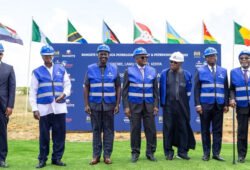
The Nigerian Upstream Petroleum Regulatory Commission has reaffirmed its commitment to building a business-enabling regulatory environment and advancing the federal government’s gas agenda following a strategic engagement with the management of Nigeria LNG Limited, with both institutions pledging closer collaboration to strengthen the upstream gas supply chain critical to the country’s energy expansion objectives.
Commission Chief Executive Oritsemeyiwa Eyesan, receiving the NLNG Managing Director Adeleye Falade and his delegation, described the commission’s evolving regulatory posture as one deliberately designed to function as a business enabler rather than a compliance enforcer. “We are deliberately repositioning the commission as a business enabler. Through our monthly stakeholder engagements, we examine industry performance and resolve issues proactively to ensure they do not escalate,” she said.
Eyesan linked the administration’s responsiveness to the oil and gas sector to improved investor confidence and increased final investment decisions, and described the Decade of Gas programme as a practical framework for expanding domestic gas utilization while simultaneously strengthening Nigeria’s export capacity.
Falade, for his part, stressed the centrality of upstream collaboration to sustaining gas supply for NLNG’s operations, and described the company’s domestic liquefied petroleum gas strategy as a deliberate market development intervention rather than a response to reduced production. “Today, 100 percent of our LPG production is dedicated to the domestic market, not due to reduced output, but because demand has expanded significantly,” he said.
He highlighted Train 7, expected to commence production next year, as a transformative addition that would increase NLNG’s production capacity by approximately 35 percent, positioning the company to scale both domestic supply and export volumes to levels that would meaningfully advance the federal government’s gas target of 12 billion standard cubic feet per day by 2030.