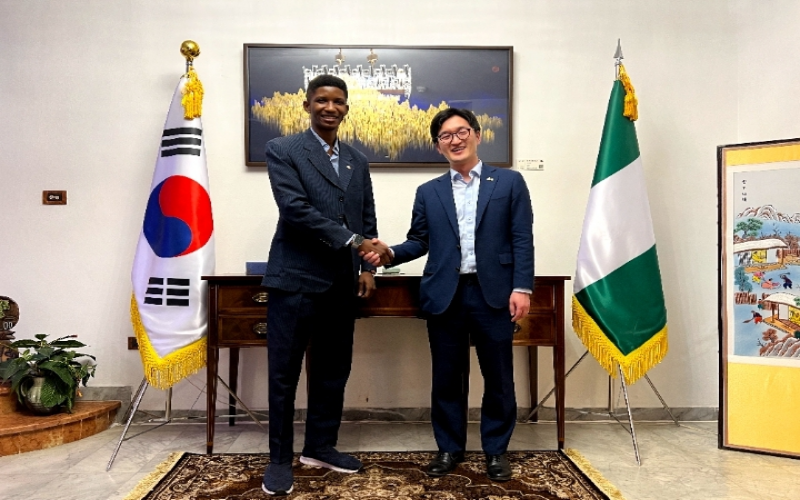
The Chargé d’Affaires of the Embassy of the Republic of Korea in Nigeria, Tak Namgung, has declared that the era of aid-driven bilateral engagement between developed and developing nations had reached its structural limits and called for a fundamentally new model of partnership anchored in trade, investment, knowledge transfer, and shared institutional development rather than the increasingly unsustainable donor-recipient dynamic that had defined decades of Africa-world relations.
Namgung made the declaration at a joint seminar organised by the Nigerian Institute of International Affairs and the Korean Embassy in Lagos on the theme “Engaging Africa in the Face of Dwindling Foreign Aid and Assistance,” where he disclosed that global aid had fallen to approximately $174 billion in 2025, representing a 23 percent decline, the sharpest single-year drop in recent history, with bilateral aid to Sub-Saharan Africa expected to fall by as much as 28 percent.
He was candid about what the figures meant for the bilateral relationship. “I will not stand here and promise more money. That would not be honest and it would not reflect the reality we are facing. Aid alone is no longer enough to sustain meaningful partnerships. The old model where one side gives and the other receives is reaching its limits,” he said.
Namgung outlined a Korea-Nigeria partnership framework built around complementary economic strengths, noting that South Korea depended on imports for over 95 percent of its critical minerals while Nigeria held vast reserves of lithium, graphite, and other materials essential to the electric vehicle and clean energy industries that South Korea was aggressively developing. He said the goal was not a simple commodity trade arrangement but genuine value co-creation in which industrial development generated jobs locally and connected Nigerian businesses to global supply chains.
He also highlighted South Korea’s security investments in the Gulf of Guinea, including a $3 million contribution to a maritime security project with the International Maritime Organisation and the transfer of a patrol vessel to the Nigerian Navy, describing these as long-term investments in the stability that economic growth required rather than gestures of charity.
NIIA Director General Professor Eghosa Osaghae welcomed the framing, saying Nigeria was no longer interested in aid packages without concrete and measurable deliverables, and urged Korea to replicate in Nigeria the ICT sector transformation it had facilitated in Rwanda. Seminar chairman Professor Femi Otubanjo made the pointed observation that Nigeria was bleeding an estimated $80 billion annually in illicit financial flows, arguing that stopping this haemorrhage would do far more for the country’s development than any volume of external aid, and challenging both governments to make illicit financial flow prevention a priority in any structured bilateral partnership.