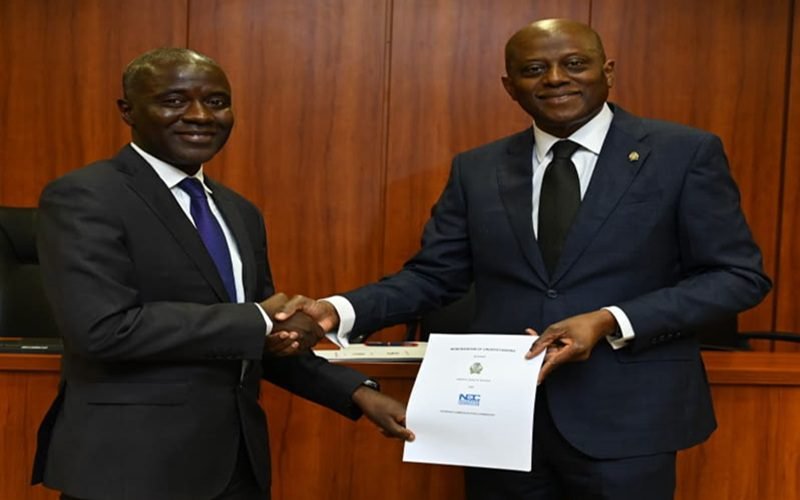
The Central Bank of Nigeria and the Nigerian Communications Commission have formalised a Memorandum of Understanding designed to deliver a safer, more resilient, and inclusive digital financial ecosystem, bringing together Nigeria’s two most powerful regulators of money and communications in a structured framework to protect consumers, curb electronic fraud, and strengthen trust in the country’s rapidly expanding digital economy.
The agreement was signed at a ceremony at the CBN headquarters in Abuja, with CBN Governor Olayemi Cardoso and NCC Executive Vice Chairman Aminu Maida presiding. The two regulators described the partnership not as a routine administrative arrangement but as a practical expression of national interest in an era where telecommunications and financial services had become inseparable.
Cardoso said the scale and complexity of today’s digital financial ecosystem had made a more comprehensive and enduring regulatory framework not just desirable but essential. He said the MoU would reinforce the stability and integrity of Nigeria’s payment infrastructure, strengthen the joint response to electronic fraud, and significantly improve protections for consumers across the financial system.
He highlighted the ability to verify mobile number status in real time across banks, financial technology companies, and other digital platforms as a critical layer of consumer protection, stressing that the agreement would ensure this capability was governed by clear standard operating guidelines and strict compliance with Nigeria’s data protection requirements, including encryption and consent protocols.
At the same ceremony, Cardoso inaugurated two joint committees: the Joint Committee on Payment System and Consumer Protection, and the Joint Committee on Telecom Identity Risk Management Portal, a secure regulatory-backed data-sharing platform designed to prevent fraud linked to recycled, swapped, or blacklisted mobile numbers. He said the committees would provide structured coordination, resolve operational frictions, recommend improvements, and report progress to ensure the partnership delivered tangible outcomes.
“We will continue to encourage innovation, but we will also insist on responsibility: robust infrastructure capacity, strong controls, responsive complaint handling, and full compliance with applicable laws and regulatory directives,” Cardoso said.
He said the agreement would support stronger authentication for higher-risk transactions, effective transaction monitoring, functional fraud reporting channels, and a harmonised consumer education programme with particular focus on underserved populations and small businesses most exposed to digital fraud.
Maida described the MoU as an important milestone in the regulatory stewardship of Nigeria’s digital economy, saying it reflected a shared commitment to financial system stability, digital inclusion, and consumer protection in an increasingly interconnected environment.
He specifically highlighted the consumer protection dimension of the agreement. “With this handshake, consumers who experience issues such as airtime recharges that do not deliver value can be assured of prompt resolution within the shortest possible time,” he said.
Maida also outlined the technical architecture underpinning the fraud prevention framework, explaining that through the Telecom Identity Risk Management System portal, financial institutions would gain enhanced visibility into the status of mobile numbers, including whether a number was active, had been swapped, had been disconnected and reassigned, or had been flagged for suspicious or fraudulent activity.
The NCC boss noted that the partnership built on a track record of productive collaboration between both regulators, citing the joint resolution of the long-standing USSD debt standoff as an example of what structured regulatory cooperation could achieve in addressing complex cross-sector challenges.